 5
 L/24 → L/43
 30 → 50 mm
 18.8 → 23.6 t
 42 → 1,927
Two versions
From support tank to main tank
The B carried the short 7.5 cm, a gun for high-explosive, behind 30 mm of steel. Four years later the G had the long 7.5 cm, a real anti-tank gun, and 50 mm on its front. The hull and running gear are the same design: eight small road wheels a side on leaf springs.
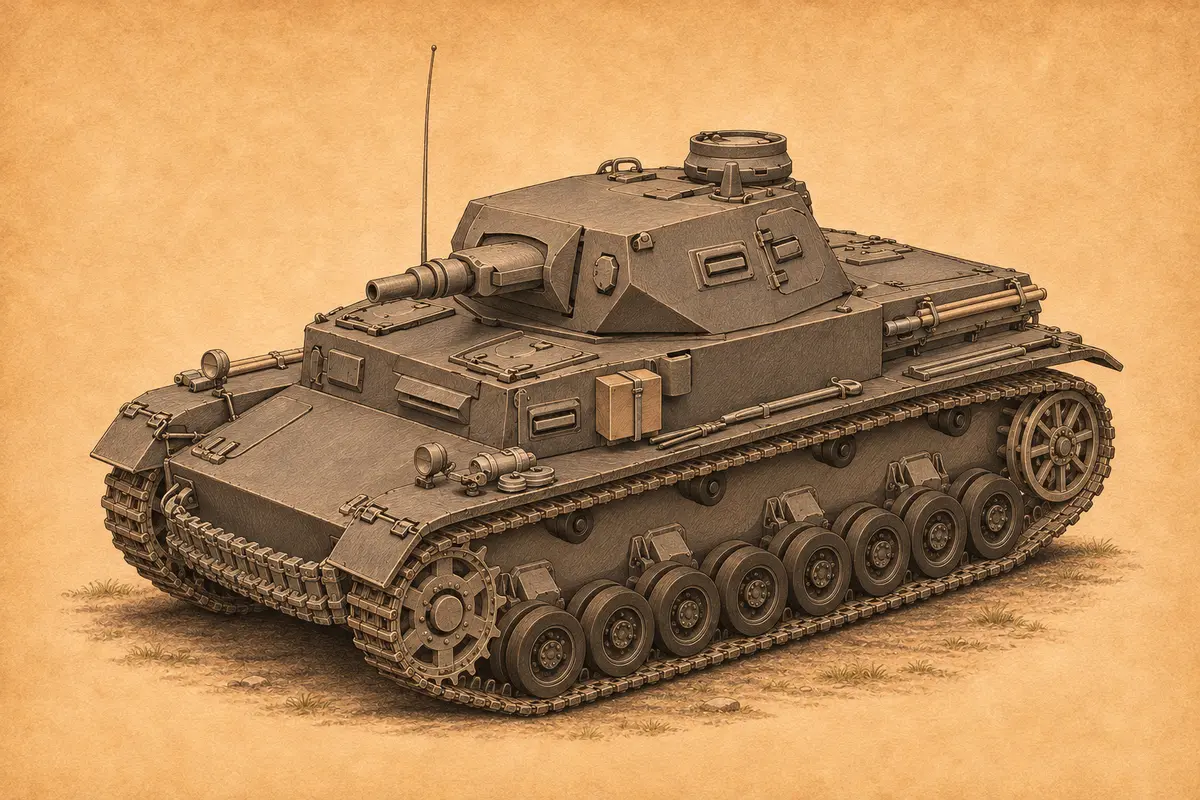
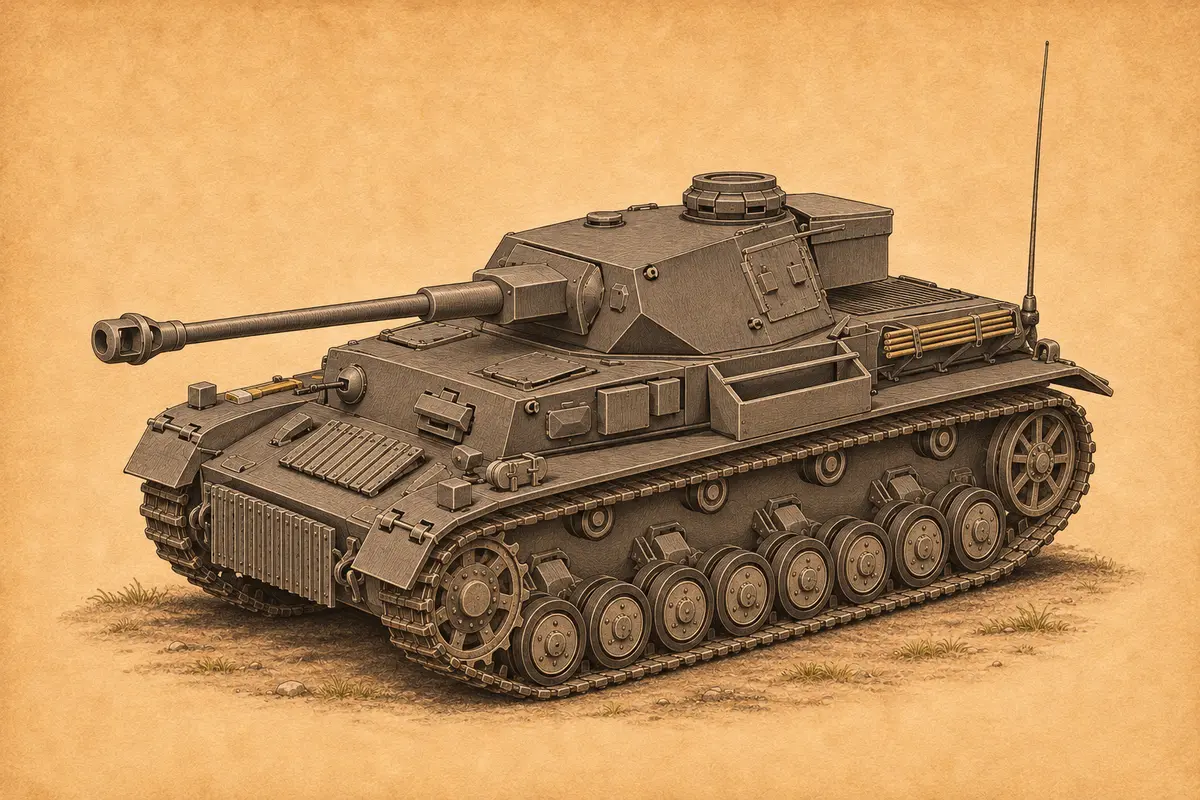
| Ausf. B | Ausf. G | |
|---|---|---|
| Built | 42, in 1938 | 1,927, March 1942 – June 1943 |
| Guns | 7.5 cm KwK 37 L/24, coaxial MG 34 | 7.5 cm KwK 40 L/43, coaxial and bow MG 34 |
| Front armour | 30 mm | 50 mm |
| Engine | Maybach HL 120 V-12, 300 PS at 3,000 rpm; six-speed gearbox | |
| Running gear, each side | 8 road wheels in pairs on leaf springs, 4 return rollers | |
| Weight | 18.8 t | 23.6 t |
| Length × width × height | 5.92 × 2.83 × 2.68 m | 5.89 (6.35 with gun) × 2.93 × 2.59 m |
| Road speed | 40 km/h | 32 km/h |
| Range on roads | 200 km | 209 km |
| Ammunition | 79 rounds, 2,550 for the MG | 87 rounds, 2,250 for the MGs |
The turret
A turret that turns itself
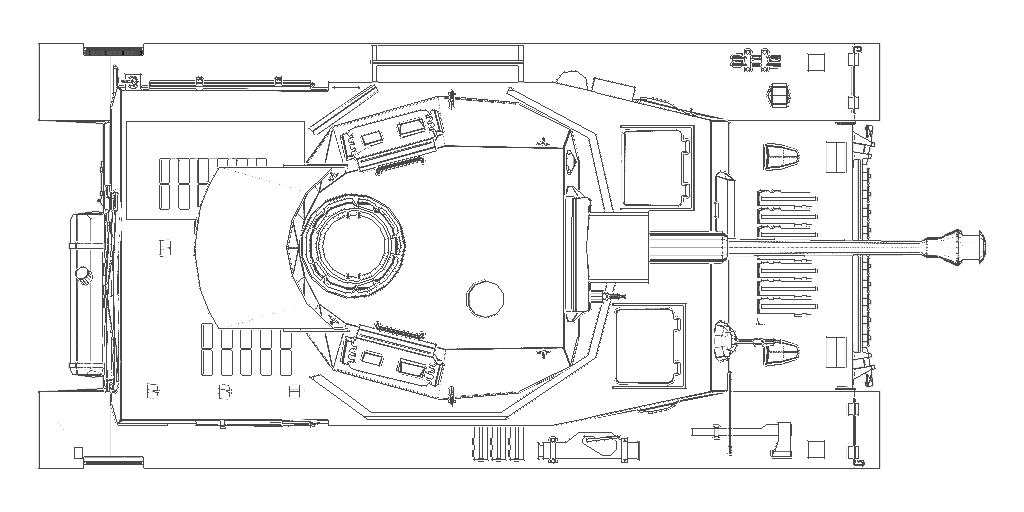
Like the Panzer III, the Panzer IV has a three-man turret: commander in the cupola, gunner and loader beside the gun. Unlike it, the turret has an electric traverse, driven by its own small generator, so the gunner can swing the gun round at about 16° a second instead of winding it by hand.
- The sights. T.Z.F. 5b on the B, 5f on the G: telescopes of about 2.5× with a 25° field.
- No hull MG on the B. Its front had a visor and a pistol port where later versions carry the radio operator’s machine gun.
- Turned by hand too. When the power is off, the hand wheel turns the turret about 2° a second.
Ballistics
The short gun and the long one
The same 75 mm bore, two very different guns. The short L/24 fires a heavy shell slowly, made for high-explosive; the long L/43 fires its armour-piercing shell twice as fast. The table shows flight time and steel pierced at a plate sloped 30°, as the game computes them.
| 7.5 cm KwK 37 L/24 | 7.5 cm KwK 40 L/43 | |
|---|---|---|
| On | Ausf. B | Ausf. G |
| Armour-piercing | K.Gr.rot Pz, 6.80 kg at 385 m/s | Pzgr 39, 6.80 kg at 750 m/s, 17 g charge |
| Hard core | — | Pzgr 40, 4.10 kg at 930 m/s |
| Shaped charge | not carried on this card | Gr 38 Hl/C, 5 kg at 450 m/s, ≈ 100 mm at any range |
| High-explosive | Sprgr 34, 5.74 kg at ≈ 420 m/s, ≈ 686 g filler | Sprgr 34, 5.74 kg at 550 m/s, 680 g filler |
| Range | L/24 · K.Gr.rot Pz | L/43 · Pzgr 39 | L/43 · Pzgr 40 | |||
|---|---|---|---|---|---|---|
| Flight, s | Steel, mm | Flight, s | Steel, mm | Flight, s | Steel, mm | |
| 100 m | 0.26 | 41 | 0.13 | — | 0.11 | — |
| 500 m | 1.35 | 39 | 0.70 | ≈ 93 | 0.57 | ≈ 124 |
| 1,000 m | 2.79 | 35 | 1.45 | ≈ 83 | 1.21 | ≈ 104 |
| 1,500 m | 4.34 | — | 2.27 | ≈ 74 | 1.93 | ≈ 87 |
| 2,000 m | 6.00 | — | 3.16 | — | 2.74 | ≈ 72 |
- Twice as fast, twice the steel. At 1,000 m the B’s shell pierces 35 mm, the G’s about 83 mm, and gets there in half the time.
- The short gun aims to 1,200 m. Its sight is graduated no further for armour-piercing; past that the table shows only flight time.
- The shaped charge does not slow down. The G’s Gr 38 Hl/C pierces the same at 100 m and at 1,500 m, because its jet, not its speed, does the work.
The B’s figures are published German tables (Panzerworld). The G’s come from H.Dv. 119/324 (1943), which covers the L/43 and the L/48 in one table: the game uses those figures for the L/43, marked ≈. Flight times are the game’s drag model, fitted to each round. — means no figure in our sources.
Protection
From 30 to 50 mm
The B was the first Panzer IV with 30 mm on its front, but its sides and turret stayed thin. The G has 50 mm on its nose, driver’s plate, turret front and mantlet, and 30 mm on its sides: enough to stop the Soviet 45 mm gun beyond close range, not the 76 mm.
- The B’s thin plates are estimates. Its front is sourced; its turret, sides and rear wait for the plate table of its manual.
- The G’s plates were measured. British engineers took a captured G apart at Chobham in 1943 and wrote down every plate; the game uses their figures.
- No skirts. The game’s G is the version before the side plates of 1943.
| Plate, mm | B | G |
|---|---|---|
| Hull front | 30 | 50 |
| Glacis | 30 | 25 |
| Turret front | ≈ 20 | 50 |
| Hull sides | ≈ 15 | 30 |
| Turret sides | ≈ 15 | 30 |
| Rear | ≈ 15 | 20 |
| Roof and deck | ≈ 10 | 10 |
| Belly | ≈ 10 | 10 |
The game’s plates. B: History of War and the game’s prepared data, ≈ for the estimates. G: School of Tank Technology report on chassis 83072, 1943.
Crew and radio
Five men and a FuG 5
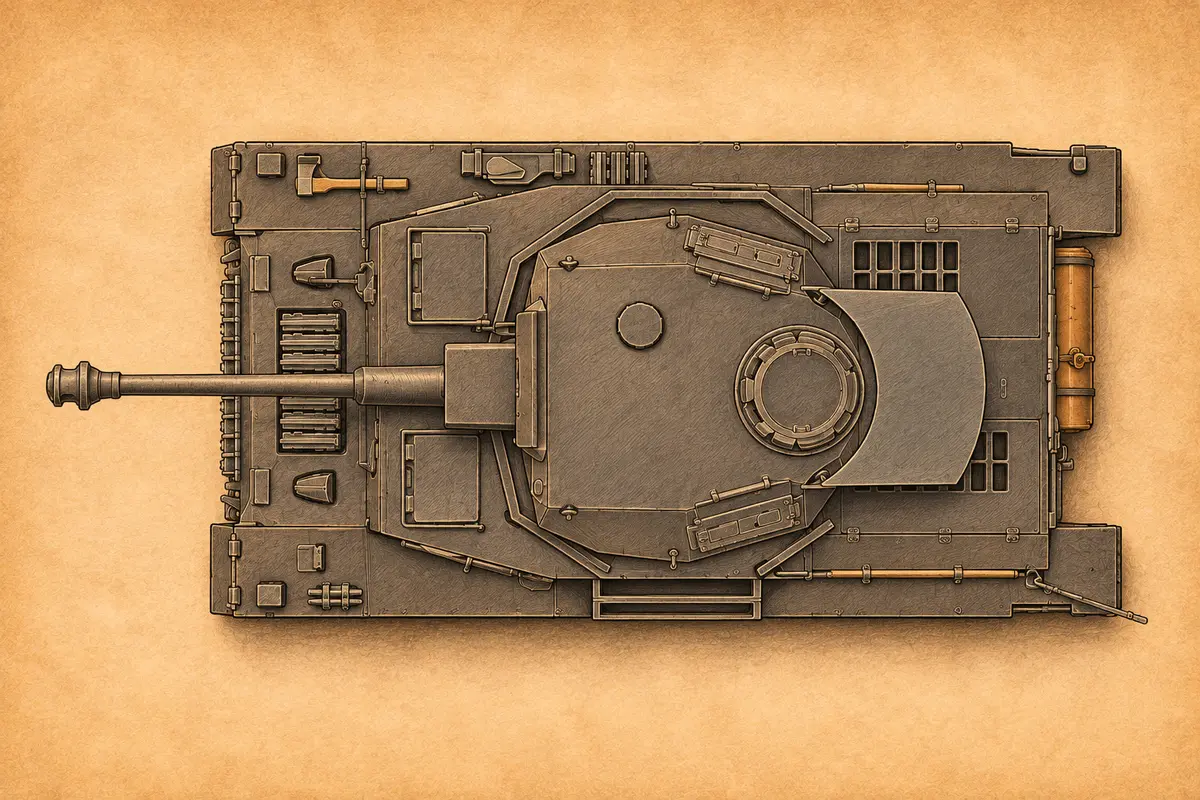
Commander, gunner and loader in the turret; driver and radio operator in the hull. The radio operator works the FuG 5, which transmits as well as receives, and on the G fires the bow machine gun.
In PINCERLOCK that means each Panzer IV can pass on what it sees to the rest of its side. The G keeps its spare track links, tools and stowage bin, and each is a part a round can hit.
In PINCERLOCK
Against the IS-2
Both versions are playable German cards. On the game’s range an IS-2 fired its 122 mm armour-piercing shell at Panzer IV Gs at 100, 500 and 1,000 m: of nine shots eight hit, all eight went through, and every Panzer IV was knocked out by its first hit.
- The B is a support tank: its high-explosive shell is strong against men and guns, its armour-piercing shell weak against tanks.
- The G has a real anti-tank gun: about 93 mm of sloped steel at 500 m, and a shaped charge for close work.
- Neither stops a 122 mm. Its 50 mm front is no match for the IS-2’s gun at any range of the test.
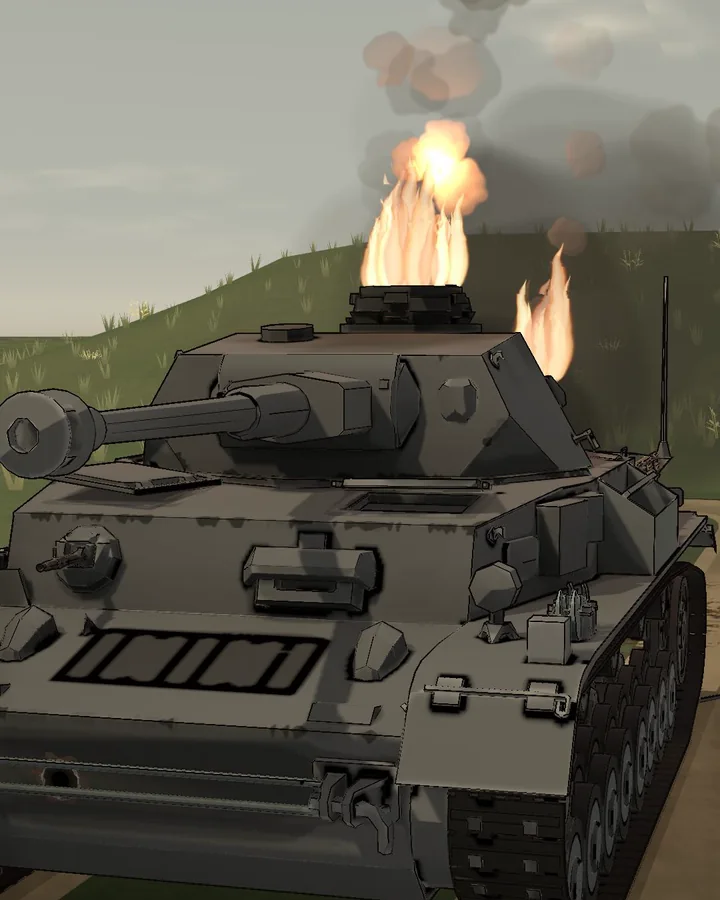
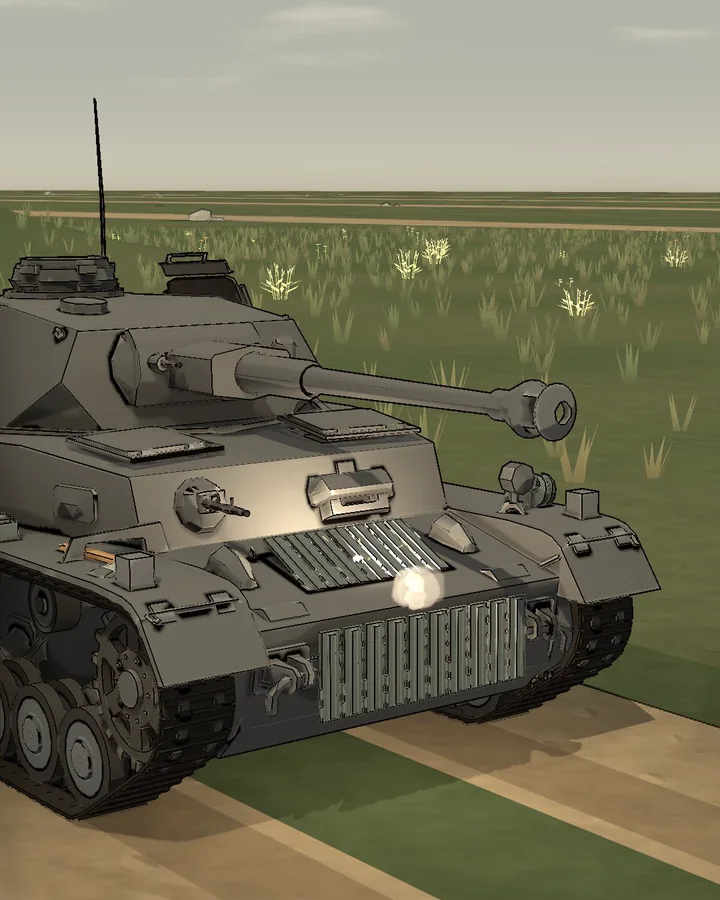
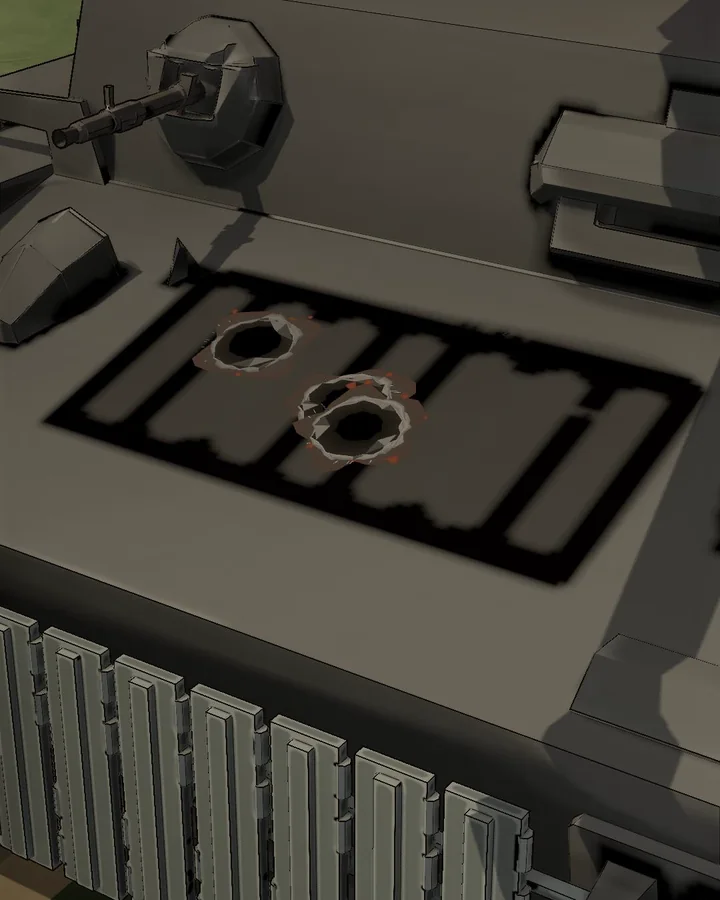
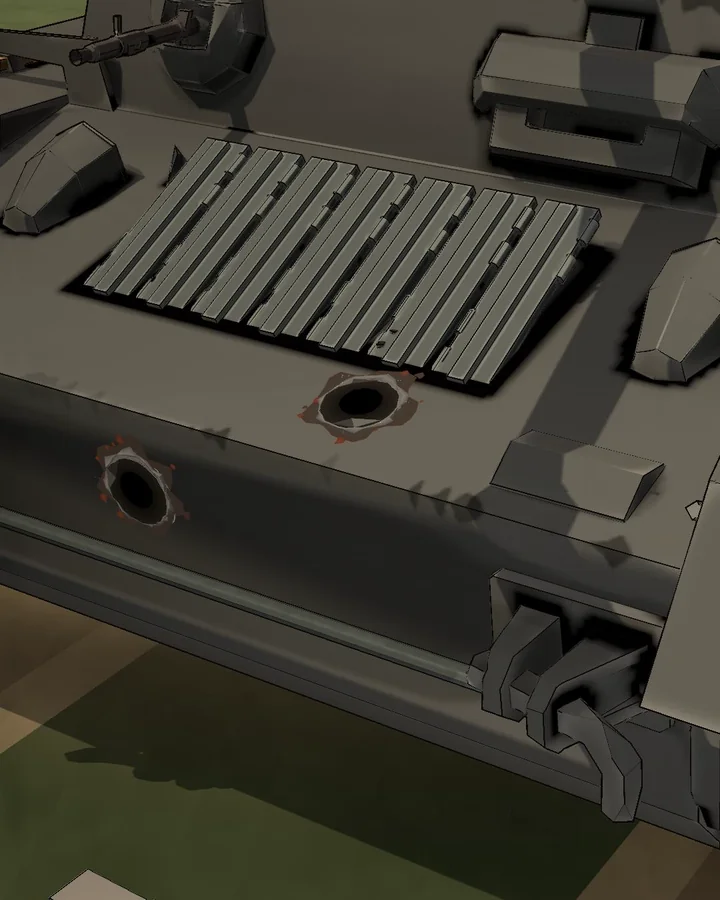
In-game footage: IS-2 against Panzer IV Ausf. G, recorded range test
Sources
Where the figures come from
The figures on this page are the Panzer IV data the game is built on. The G’s research is finished, the B’s is a draft; what our sources do not settle is marked ≈ or left out.
- School of Tank Technology, Preliminary Report Special No. 15, August 1943: a captured Ausf. G, chassis 83072, examined at Chobham.
- TM-E 30-451, US War Department, March 1945: the Panzer IV’s weight, speed and range.
- H.Dv. 119/324, October 1943: the firing table of the 7.5 cm KwK 40.
- Published references (History of War, Panzerworld, Wikipedia): the Ausf. B, production, the short gun’s tables.
≈ marks estimates; — means the figure is not in our sources. Pictures are taken from the game’s own models; footage is recorded in the game.