 5
 3.7 → 5 cm
 15 → 57 mm
 15.4 → 22.5 t
 1937 → 1942
Three versions
From prototype to workhorse
The Ausf. A was a trial series: thin armour, a 3.7 cm gun and five big wheels on coil springs. By the Ausf. J the Panzer III had torsion-bar suspension, 50 mm of steel on its front and a 5 cm gun; the Ausf. L kept that hull, thickened the turret front and took the long 5 cm gun.
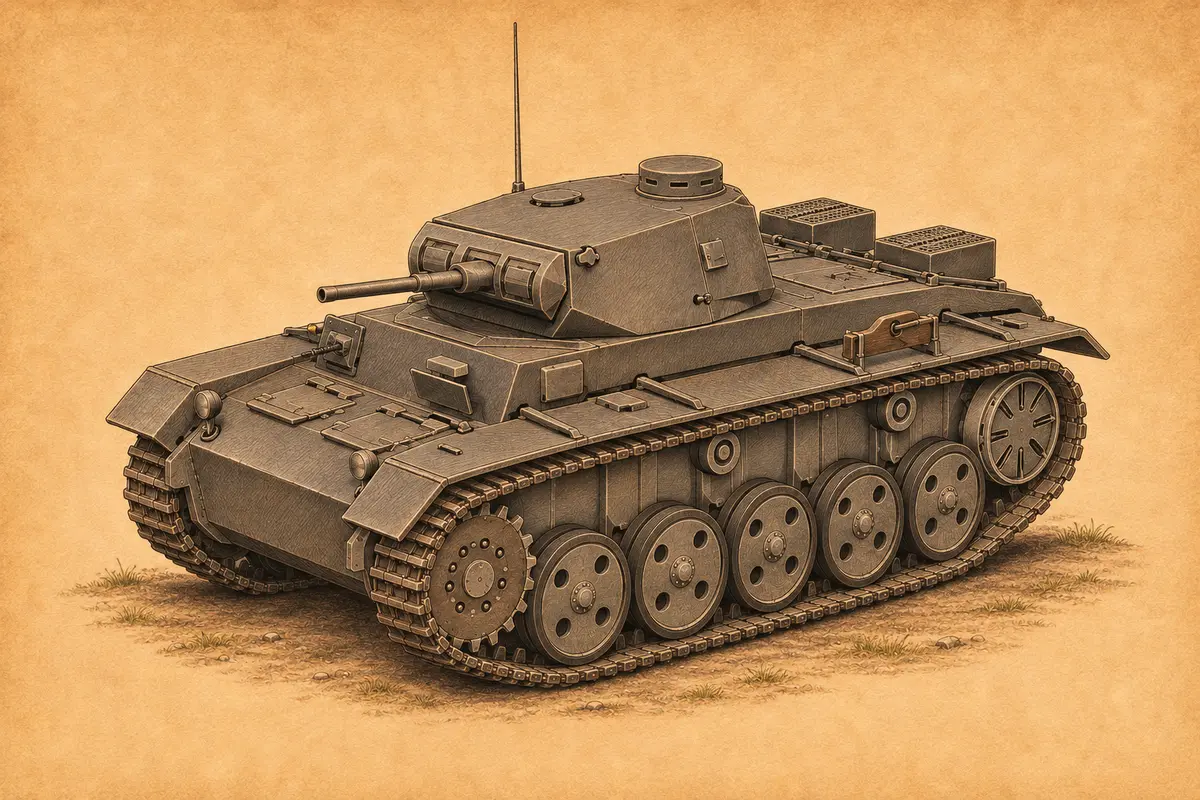
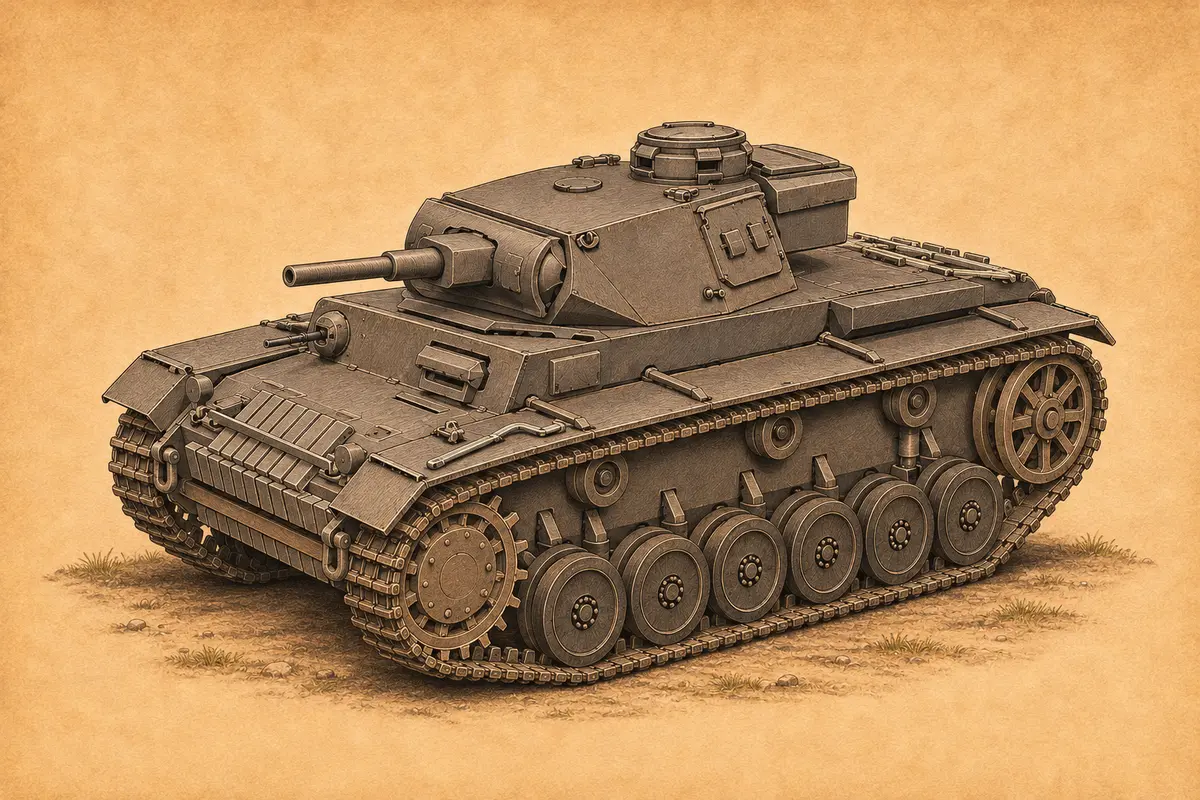
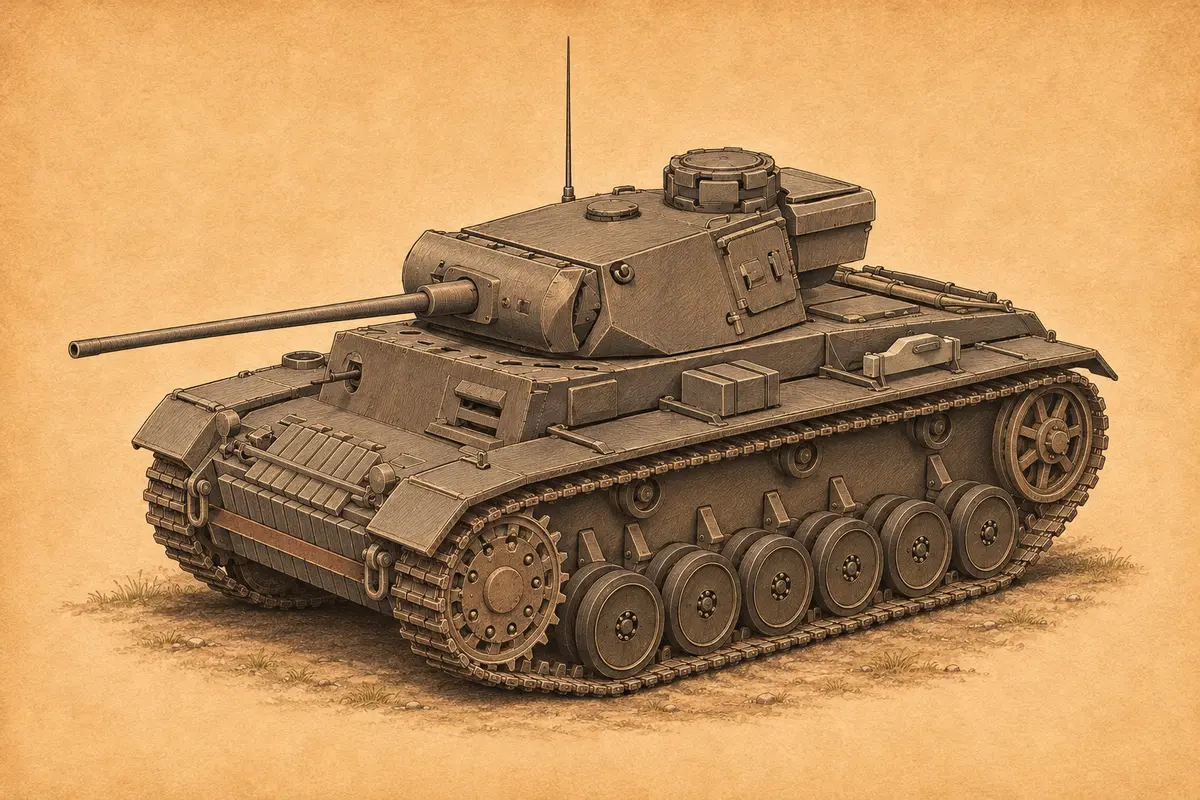
| Ausf. A | Ausf. J | Ausf. L | |
|---|---|---|---|
| Built | 10, in 1937 | — | 653, June–December 1942 |
| Guns | 3.7 cm KwK 36 L/45, two coaxial MG 34, bow MG 34 | 5 cm KwK 38 L/42, coaxial and bow MG 34 | 5 cm KwK 39 L/60, coaxial and bow MG 34 |
| Front armour | 15 mm | 50 mm | 50 mm, 57 mm turret front, 20 mm spaced plate |
| Engine | Maybach HL 108 TR, V-12, 250 PS at 2,800 rpm | Maybach HL 120 TRM, V-12, 300 PS at 3,000 rpm | |
| Running gear, each side | 5 large road wheels on coil springs, 2 return rollers | 6 road wheels on torsion bars, 3 return rollers | |
| Weight | 15.4 t | ≈ 21.5 t | 22.5 t |
| Road speed | ≈ 32 km/h | — | 40 km/h |
| Range on roads | 165 km | — | 155 km |
| Ammunition | 120 rounds, 4,425 for the MGs | — | 78 rounds, 3,750 for the MGs |
The turret
A commander who only commands
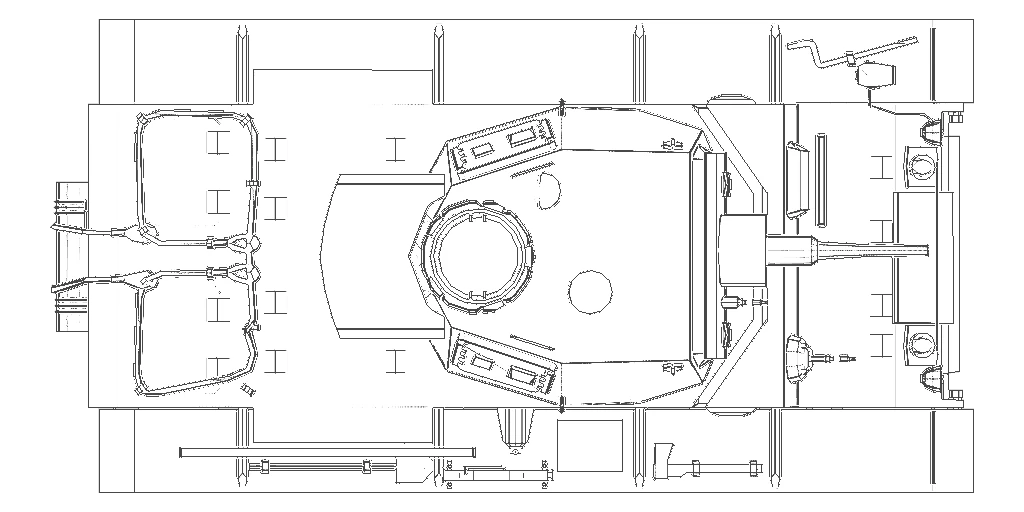
In the Panzer I, II and 38(t) the commander also aimed the gun. The Panzer III gave him a gunner and a loader: three men in the turret, the commander in a cupola behind the gun, free to watch the fight and direct it. Below them the driver and the radio operator, who also fires the bow machine gun.
- The sights. T.Z.F. 5a on the A, 5d on the J, 5e on the L: telescopes of 2.5× with a 25° field.
- Two coaxial MGs on the A. The first Panzer IIIs had two MG 34s beside the gun; later versions kept one.
- Turned by hand. No power traverse: the gunner winds the turret round, about 4° a second on the A (≈).
Ballistics
Three guns compared
Each version has its own gun, and the game carries each with its own rounds. The table puts their armour-piercing shells side by side: flight time and steel pierced at a plate sloped 30°, as the game computes them.
| 3.7 cm KwK 36 L/45 | 5 cm KwK 38 L/42 | 5 cm KwK 39 L/60 | |
|---|---|---|---|
| On | Ausf. A | Ausf. J | Ausf. L |
| Armour-piercing | Pzgr, 685 g at 745 m/s, 13 g charge | Pzgr 39, 2.06 kg at 685 m/s, 17 g charge | Pzgr 39, 2.06 kg at 835 m/s, 17 g charge |
| Hard core | not carried on this card | Pzgr 40, 925 g at 1,050 m/s | Pzgr 40/1, 1.06 kg at 1,130 m/s |
| High-explosive | Sprgr 18 umg., 617 g, ≈ 745 m/s | Sprgr 38, 1.82 kg, 170 g filler, ≈ 450 m/s | Sprgr 38, 1.82 kg at 550 m/s, 170 g filler |
| Range | KwK 36 · Pzgr | KwK 38 · Pzgr 39 | KwK 39 · Pzgr 39 | |||
|---|---|---|---|---|---|---|
| Flight, s | Steel, mm | Flight, s | Steel, mm | Flight, s | Steel, mm | |
| 100 m | 0.14 | 34 | 0.15 | 55 | 0.12 | 69 |
| 500 m | 0.72 | 29 | 0.80 | 47 | 0.65 | 59 |
| 1,000 m | 1.55 | 23 | 1.74 | 37 | 1.41 | 48 |
| 1,500 m | 2.51 | 19 | 2.85 | 28 | 2.30 | 38 |
| 2,000 m | 3.62 | 15 | 4.18 | 22 | 3.35 | 29 |
- The long gun is the same shell, faster. The L’s Pzgr 39 leaves the muzzle 150 m/s quicker than the J’s and pierces about a quarter more at every range.
- Hard-core rounds hit hardest close in: the L’s Pzgr 40/1 pierces 116 mm at 100 m against a 30° plate, but only 44 mm by 1,000 m.
- Why the 3.7 cm went. 34 mm at 100 m was enough for the light tanks of 1939; against 45 mm sloped plate it was not, and from the Ausf. F onward the Panzer III took the 5 cm.
Penetration figures are published German tables (Panzerworld); the A’s 3.7 cm rounds come from the game’s prepared data and German manuals; the L’s from TM 9-1985-3. Flight times are the game’s drag model, fitted to each round’s penetration curve. The J has no data sheet of its own yet: its figures are the game’s seed data.
Protection
From 15 to 57 mm
The A was protected like a light tank: 15 mm all round. By the J the front and rear were 50 mm, face-hardened at the front, and the sides 30 mm. The L thickened the turret front to 57 mm and could carry a 20 mm spaced plate in front of the driver and the mantlet.
- The spaced plate is an extra. In the game the L’s 20 mm Vorpanzer is an additional fitting, not yet given to a normal deployment.
- Face-hardened fronts. The J’s and L’s 50 mm front plates are hardened on the outside, which breaks up uncapped shells.
- In the game every plate is a plate. Each round is traced through the tank’s own measured plates, hatches, wheels and tools at the angle it strikes.
| Plate, mm | A | J | L |
|---|---|---|---|
| Hull front | 15 | 50 | 50 (+20) |
| Turret front | 16 | 50 | 57 |
| Hull sides | 15 | 30 | 30 |
| Turret sides | 15 | 30 | 30 |
| Rear | 15 | 50 | 50 |
| Roof and deck | 10 | 16 | 16 |
| Belly | 5 | 16 | 16 |
The game’s plates. A: 14.5 mm in period sources, rounded to 15. J: History of War after Chamberlain & Doyle. L: TM-E 30-451 (1945); (+20) is the spaced plate.
Crew and radio
Five men and a radio that answers
Commander, gunner and loader in the turret; driver and radio operator in the hull. Every Panzer III carries a FuG 5 that transmits as well as receives, worked by the radio operator.
In PINCERLOCK that means each Panzer III can pass on what it sees to the rest of its side, and its commander’s cupola gives it a good view of the field.
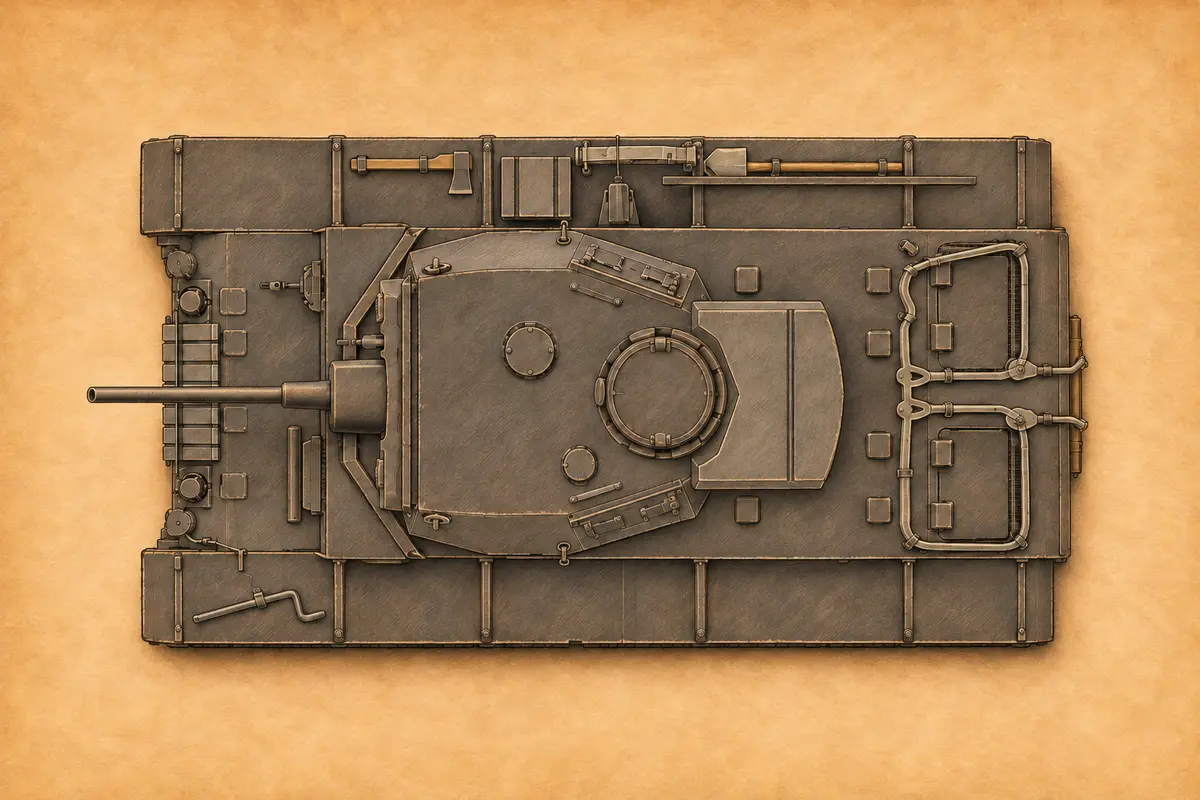
In PINCERLOCK
Tested on the range
All three versions are playable German cards. The Ausf. A was put against a BT-5 on the game’s range, both ways: of twelve 45 mm shots the BT-5 hit ten and went through five times, through the A’s 15 mm front and its tracks, and set its ammunition burning, but knocked none of the three out.
- The A is a 1939 tank: its 3.7 cm deals with light tanks, its armour stops only rifle bullets.
- The J fights on even terms with the Soviet light tanks and survives their guns at range.
- The L is the strongest: the long 5 cm and the hard-core Pzgr 40/1 give it a chance against heavier armour at close range.
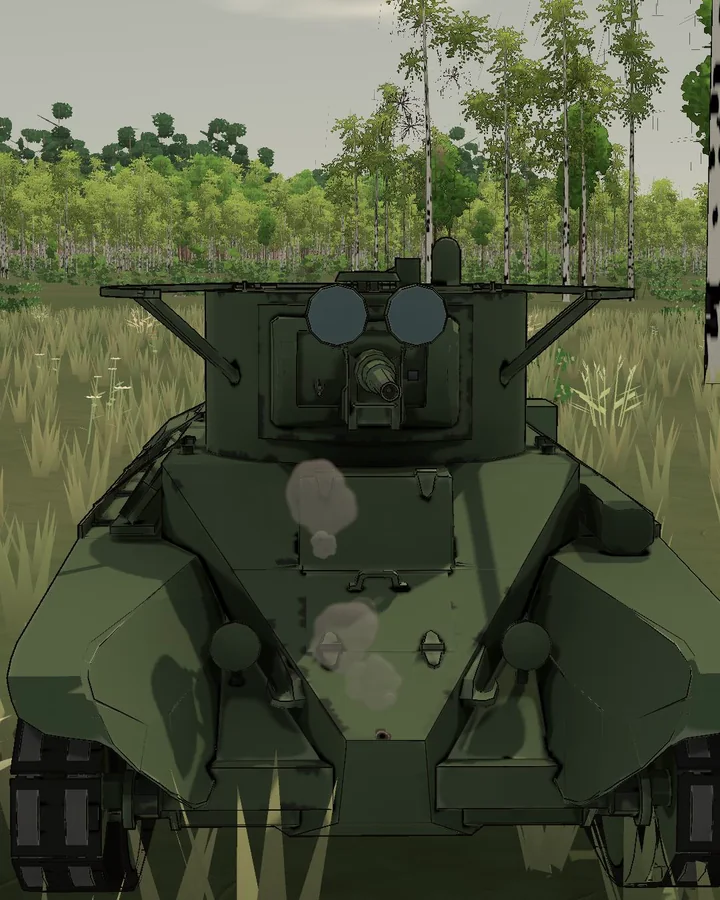
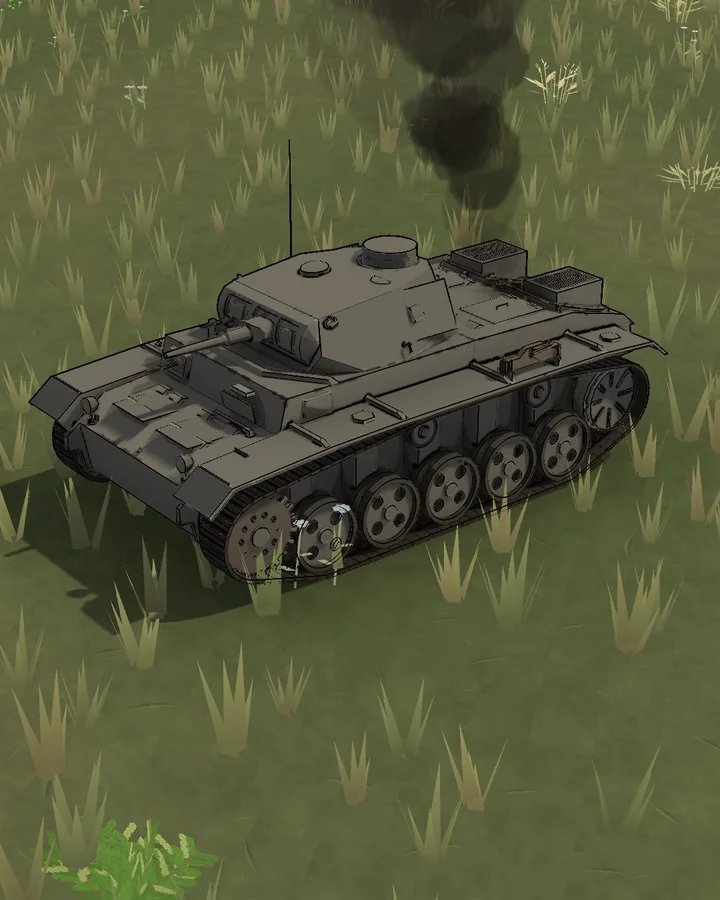
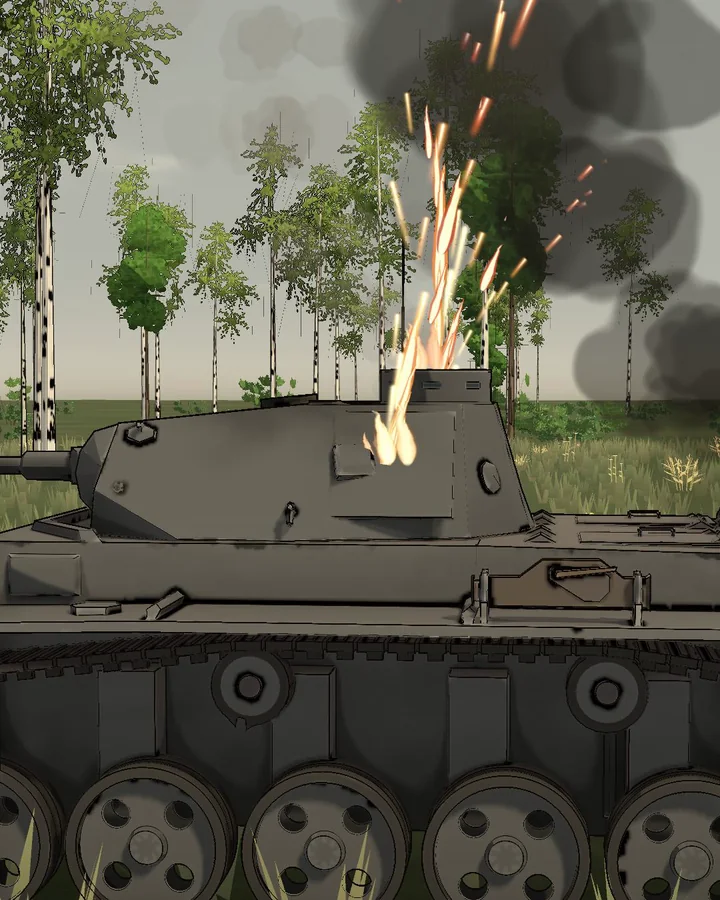
In-game footage: BT-5 against Panzer III Ausf. A and back, recorded range tests
Sources
Where the figures come from
The figures on this page are the Panzer III data the game is built on. The Ausf. A’s research is finished, the L’s is a draft, and the J has none of its own yet; what our sources do not settle is marked ≈ or left out.
- D 653/1: Maybach HL 108 TR manual (the A’s engine). D 435/1, December 1940: 3.7 cm ammunition.
- TM-E 30-451, US War Department, March 1945: Panzer III Models L and M, armour and specifications.
- TM 9-1985-3, German Explosive Ordnance: the 5 cm rounds.
- Published references (History of War, Tank Encyclopedia, Panzerworld, Wikipedia): dimensions, weights, production, penetration tables.
≈ marks estimates; — means the figure is not in our sources. Pictures are taken from the game’s own models; footage is recorded in the game.