 3
 2 cm + MG 34
 ≈ 15 mm
 8.9 t
 40 km/h
The turret
A cannon that fires in bursts
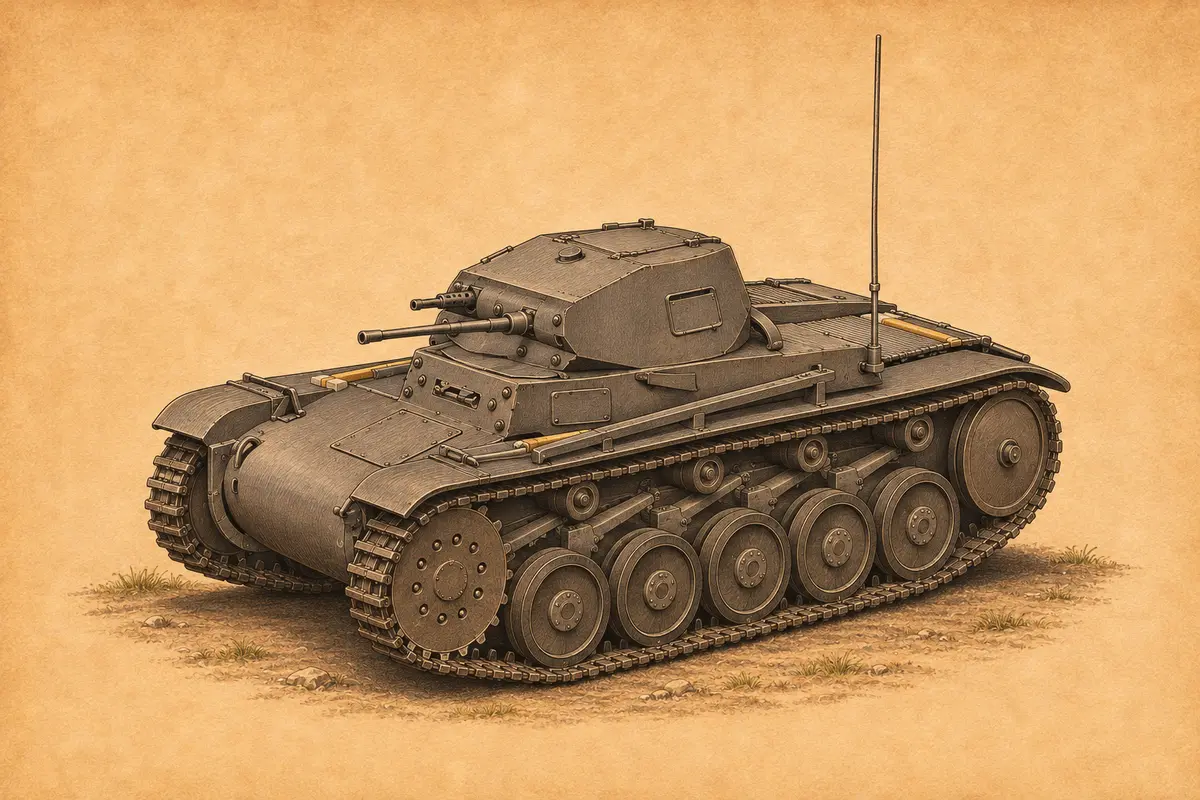
The main weapon is the 2 cm KwK 30 L/55, an automatic cannon fed from 10-round magazines, with a coaxial MG 34 to its right. The commander sits in the turret, aims through the sight and fires both; the radio operator below helps him load.
- Automatic. Single shots or bursts at about 280 rounds a minute, ten rounds to a magazine, 180 rounds carried.
- The sight. A T.Z.F. 4 telescope, 2.5× with a 25° field, graduated to 800 m and later to 1,200 m.
- Turned by hand. No power traverse: the commander winds the turret round by a handwheel, about 2° a turn (≈); the gun points from about −10° to +20° (≈).
- Three men. Commander and gunner in one, a radio operator who also loads, and the driver.
Engine and chassis
A real engine at last
A Maybach six of 140 PS drives the C through a six-speed gearbox to the front sprockets. Five large road wheels a side ride on quarter-elliptic leaf springs, with four return rollers above them.
| Engine | Maybach HL 62 TR, inline six, water-cooled, 6.19 l |
|---|---|
| Power | 140 PS at 2,600 rpm |
| Gearbox | six forward speeds, one reverse; clutch-and-brake steering |
| Running gear, each side | 5 road wheels on leaf springs, 4 return rollers, front sprocket |
| Fuel | 170 l |
| Length | 4.81 m |
| Width × height | 2.22 × 1.99 m |
| Weight | 8.9 t |
| Road speed | 40 km/h |
| Range on roads | 200 km |
| Ammunition | 180 rounds of 2 cm, 2,250 for the MG 34 |
| Built | Ausf. C: March 1937 – April 1940 |
Ballistics
What the 2 cm gun does
The KwK 30 fires the 20 × 138 mm cartridge of the 2 cm Flak. The game carries three rounds: the Pzgr armour-piercing tracer, the Pzgr 40 with its hard core, and the Sprgr high-explosive tracer. Flight times and striking speeds are the game’s own trajectory figures; penetration is against a plate sloped at 30°.
| Pzgr | Pzgr 40 | Sprgr | |
|---|---|---|---|
| Type | armour-piercing | hard-core armour-piercing | high-explosive |
| Projectile | 148 g, tracer | 100 g, hard core, tracer | 115 g, 6.2 g PETN, tracer, self-destructs |
| Muzzle velocity | 780 m/s | 1,050 m/s | 888 m/s |
| Rounds carried (game) | 120 | 20 | 40 |
| Rate of fire | ≈ 280 rounds a minute, magazines of 10 | ||
| Sight | T.Z.F. 4, 2.5×, graduated to 1,200 m | ||
| Range | Pzgr | Pzgr 40 | ||||
|---|---|---|---|---|---|---|
| Flight, s | Speed, m/s | Steel, mm | Flight, s | Speed, m/s | Steel, mm | |
| 100 m | 0.13 | 715 | 23 | 0.10 | 930 | 40 |
| 500 m | 0.80 | 505 | 14 | 0.66 | 573 | 20 |
| 1,000 m | 2.04 | 328 | 7.5 | 1.86 | 313 | 8.4 |
| 1,200 m | 2.71 | 275 | 5.9 | 2.58 | 245 | 5.9 |
| Range | Flight, s | Speed, m/s |
|---|---|---|
| 100 m | 0.12 | 815 |
| 500 m | 0.70 | 578 |
| 1,000 m | 1.78 | 377 |
| 1,200 m | 2.36 | 317 |
- Enough for 1939. 23 mm at 100 m goes through the 13 mm of a Panzer I or the 15 mm of a T-26; the 45 mm of a T-34 it does not.
- The Pzgr 40 is for close range. Its light core starts fast and slows fast: 40 mm at 100 m, but no better than the plain Pzgr by 1,200 m. Crews were told not to fire it beyond 250 m.
- The Sprgr destroys itself after 5.5–6.5 seconds, about 2,000 m out, so it does not come down on friendly troops.
Penetration at 100 and 500 m is from published German tables; at 1,000 and 1,200 m it is extended by the same curve. The muzzle velocities are published figures; the times and speeds come from the game’s drag model, fitted to those penetration figures (for the Sprgr, to its self-destruct time).
Protection
15 mm, a little better sloped
The C keeps the Panzer I’s idea: steel enough against rifle bullets and splinters, nothing more. The front and the turret walls are sloped; the rest stands upright. This page describes the standard C without the extra plates bolted on later.
- Against rifles, not guns. Every anti-tank gun of 1939, and the 2 cm of another Panzer II at close range, goes through.
- A thick spot. The mantlet round the gun is the thickest piece, about 16 mm.
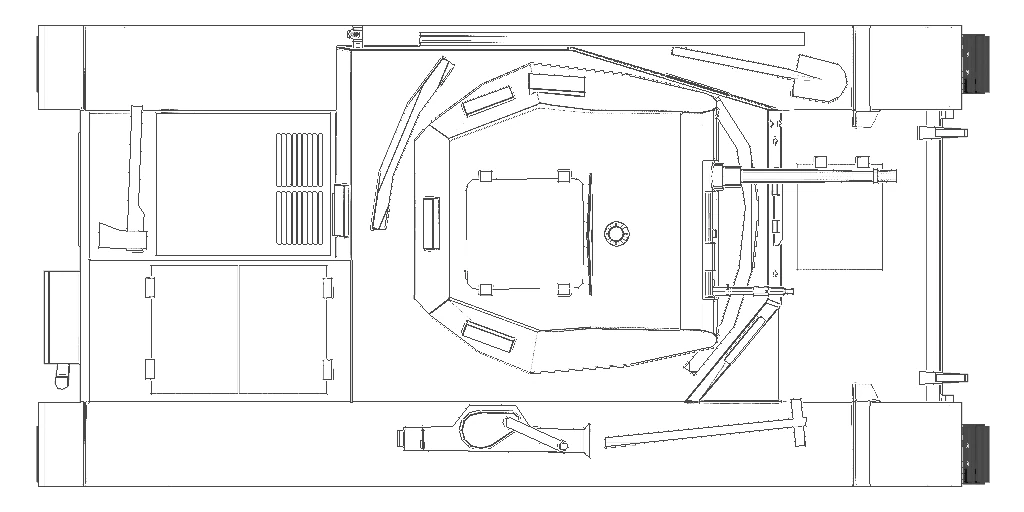
- In the game every plate is a plate. Each round is traced through the tank’s own measured plates, hatches, wheels and tools at the angle it strikes.
| Plate | Thickness | From vertical |
|---|---|---|
| Nose | ≈ 15 mm | 30° |
| Driver’s plate | ≈ 15 mm | 8° |
| Sides | ≈ 15 mm | 0° |
| Rear | ≈ 15 mm | 6–10° |
| Turret walls | ≈ 15 mm | 22° |
| Mantlet | ≈ 16 mm | 0° |
| Roofs and deck | ≈ 10 mm | flat |
| Belly | ≈ 5–10 mm | flat |
The game’s own plates. Period sources give 14.5 mm for the early C; the game rounds to 15.
Radio
This one could answer
Where the Panzer I only listened, the Panzer II carries a FuG 5 that sends as well as receives, worked by the third man from the fighting compartment, with a 2 m rod aerial that can be lowered.
In PINCERLOCK that is the difference that matters: a Panzer II can pass on what it sees to the rest of its side, where a Panzer I can only listen.
Panzerkampfwagen II, Ausf. A bis C und F. Gerätebeschreibung und Bedienungsanweisung zum Aufbau.
Panzer II, versions A to C and F. Equipment description and operating instructions for the superstructure.
D 651/9, 17 June 1941, title page
In PINCERLOCK
The light tank that can fight
The Panzer II Ausf. C is a playable German card. Fast and with a real gun for 1939, it can kill light tanks and armoured cars, and its MG 34 and high-explosive rounds deal with infantry.
- Three rounds an order. One fire order empties three rounds from the magazine, each with its own flight, hit and penetration.
- Choose the round. Pzgr for most targets, Pzgr 40 for a heavier target up close, Sprgr against men and soft vehicles.
- Every hit is physical. Bullets and shells are traced through its plates, engine, fuel, ammunition and crew.
Sources
Where the figures come from
The figures on this page are the Panzer II data the game is built on. Its research is not finished: what our sources do not confirm is marked ≈.
- D 651/9, 17 June 1941: Panzerkampfwagen II, Ausf. A to C and F, description and operating instructions for the superstructure.
- TM-E30-451, US War Department, March 1945: handbook on German military forces; the Panzer II’s crew, history and running gear.
- Published tables (Panzerworld, Wehrmacht History, Wikipedia): dimensions, weight, speed, range, fuel, the 2 cm rounds and their penetration.
- The game’s own models: plate thicknesses and angles as measured on the game’s Panzer II.
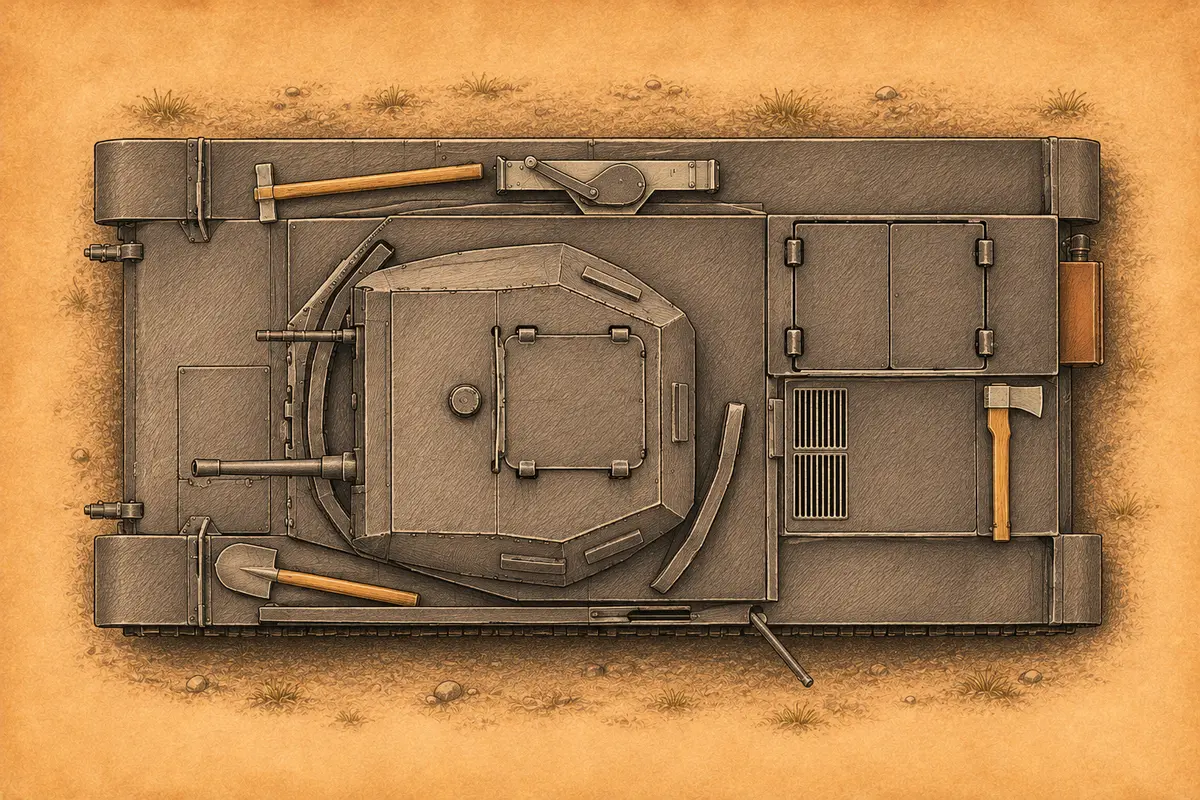
≈ marks figures the sources above do not settle: the hand traverse and elevation rates, the gun’s elevation limits and the plate thicknesses. Pictures are taken from the game’s own model.