 2
 2 × MG 13k
 13 mm
 ≈ 5.4 / 5.8 t
 ≈ 1,190 / 675
The turret
One man aims, fires, reloads and listens
The Panzer I had a crew of two. The driver sat low in the hull. Everything else fell to the commander in the small turret, set off to the right: he turned it by hand, aimed through a telescope between the guns, fired both machine guns, changed their magazines and listened to the radio.
- Two guns, two triggers. The guns are not one double weapon. The trigger on the traverse handwheel fires the right gun, the trigger on the elevation handwheel the left.
- All by hand. One turn of the traverse handwheel moves the turret 6°, one turn of the elevation handwheel raises the guns 4° 30′. The guns point from about −12° to +20°.
- The sight. A telescope of 2.5× with a 28° field, its range scale graduated to 800 m.
- Magazines of 25. The loading plan of November 1938 stows 70 magazines in an Ausf. B, 1,750 rounds. The A has no room for the 12 beside the seat and carries 58, 1,450 rounds: ordinary s.S. ball and S.m.K. steel-core armour-piercing.
Als Bewaffnung sind zwei M. G. 13 k eingebaut.
Two M.G. 13k are fitted as armament.
Eine Umdrehung des Handrades = 6° Turmdrehung.
One turn of the handwheel = 6° of turret traverse.
D 636/1, turret and superstructure manual, 1 April 1936, pp. 5 and 25
Two chassis
Same turret, different tank underneath
The A and the B share the superstructure, the turret and the guns. Under them they are different machines. The A’s air-cooled Krupp engine was weak, so the B got a longer chassis with a water-cooled Maybach six, one more road wheel and one more return roller on each side, and an idler lifted off the ground.
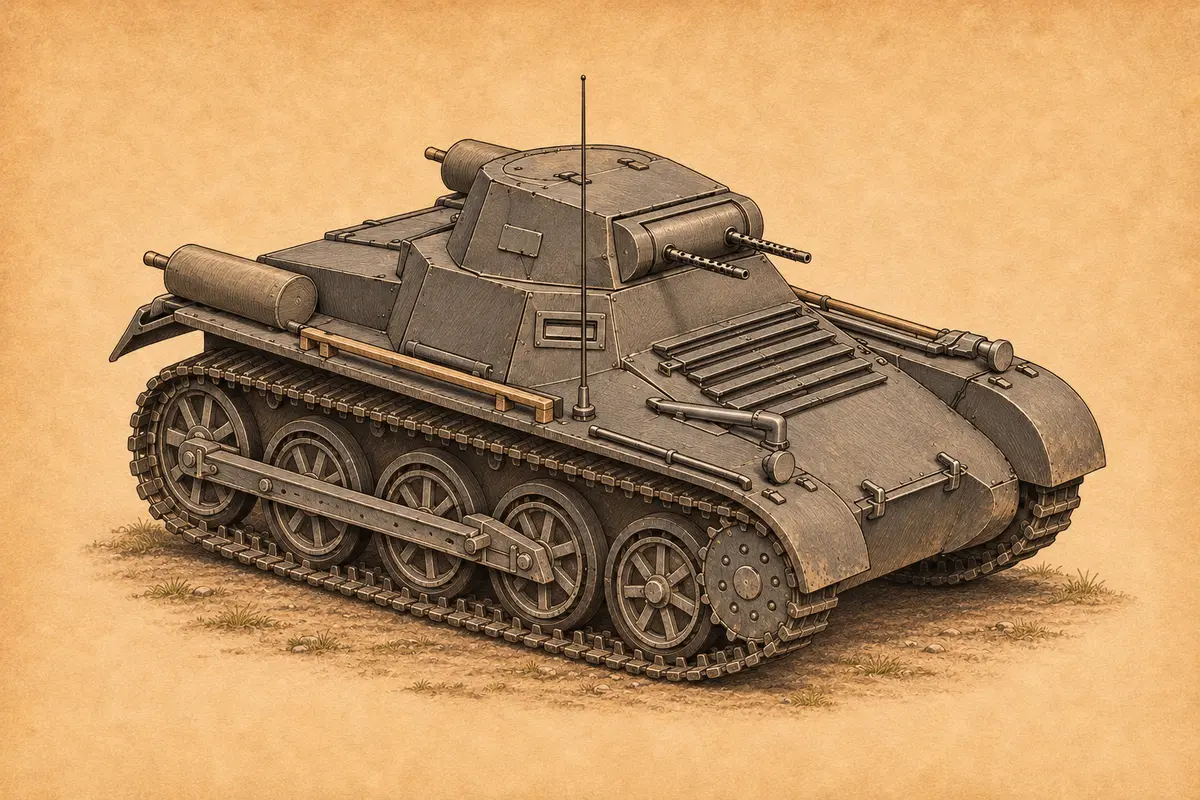
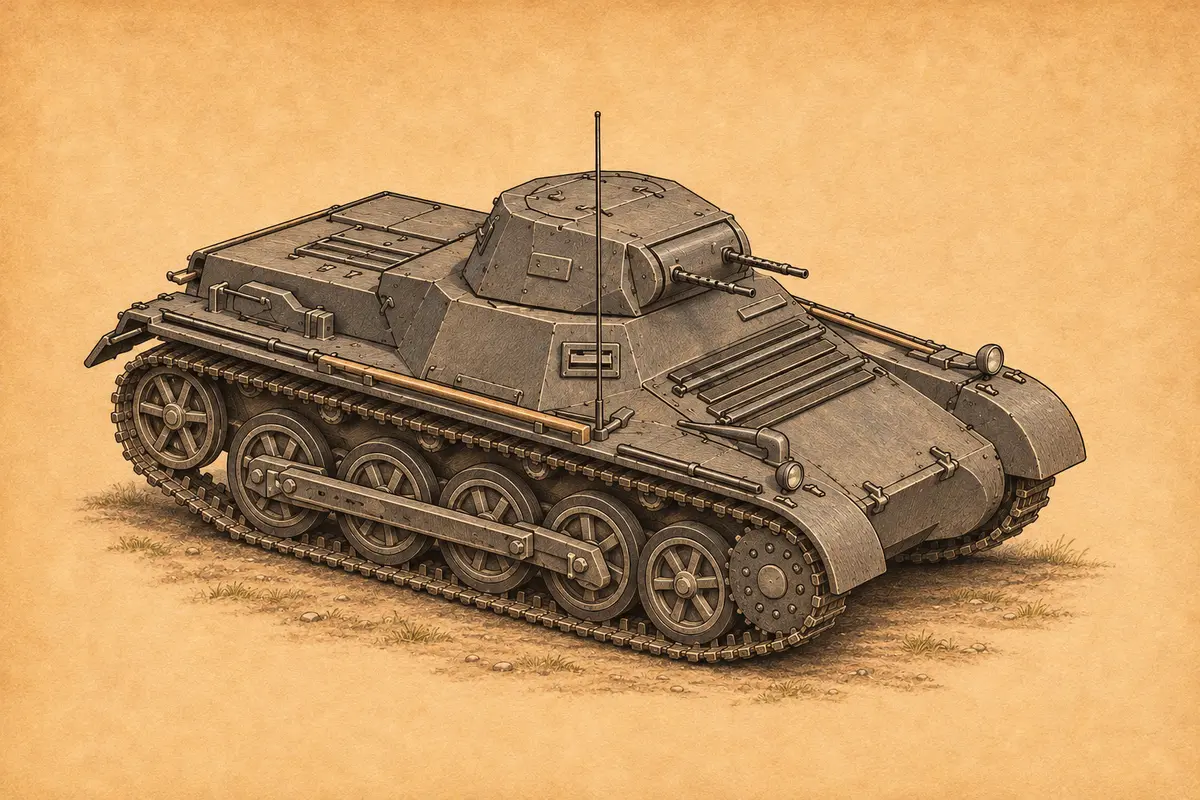
| Ausf. A | Ausf. B | |
|---|---|---|
| Engine | Krupp M 305, flat four, air-cooled | Maybach NL 38 TR, inline six, water-cooled |
| Power | 60 PS at 2,500 rpm, 3.46 l | 100 PS at 3,000 rpm, 3.8 l |
| Gearbox | Aphon FG 35, five speeds | Aphon FG 31, five speeds |
| Running gear, each side | 4 road wheels, 3 return rollers | 5 road wheels, 4 return rollers |
| Idler | low, rubber-tyred, coupled to the last wheel | raised, steel, without rubber |
| Fuel | two tanks of 72 l | 84 l and 62 l |
| Length | ≈ 4.02 m | ≈ 4.42 m |
| Width × height | ≈ 2.06 × 1.72 m | ≈ 2.06 × 1.72 m |
| Weight | ≈ 5.4 t | ≈ 5.8 t |
| Road speed | ≈ 37 km/h | ≈ 40 km/h |
| Range on roads | ≈ 145 km | ≈ 170 km |
| Magazines (1938) | 58 · 1,450 rounds | 70 · 1,750 rounds |
| Built | ≈ 1,190 · 1934–1936 | ≈ 675 · 1935–1937 |
Der luftgekühlte 60 PS Vierzylindermotor Krupp M 305 hat eine Bohrung von 92 mm, 130 mm Hub und eine Höchstdrehzahl von 2500 U/min.
The air-cooled 60 PS four-cylinder Krupp M 305 engine has a bore of 92 mm, a stroke of 130 mm and a maximum speed of 2,500 rpm.
D 650/1, Ausf. A chassis manual, 20 September 1938, p. 8
Ballistics
What its bullets do
Both guns fire the 7.92 × 57 mm rifle cartridge from a short 600 mm tank barrel. The s.S. heavy ball is the everyday round; the S.m.K. carries a hardened steel core and is the one for armour. These are the game’s own figures for each range: flight time, striking speed and the rolled steel a bullet pierces when it hits a plate square on.
| s.S. | S.m.K. | |
|---|---|---|
| Type | heavy ball | armour-piercing |
| Bullet | 12.8 g, lead core, steel-clad jacket | ≈ 11.5 g, 6 g hardened steel core |
| Muzzle velocity | ≈ 750 m/s | ≈ 780 m/s |
| Rate of fire | ≈ 550 rounds a minute per gun, magazines of 25 | |
| Sight | 2.5× telescope, range scale to 800 m | |
| Range | s.S. | S.m.K. | ||||
|---|---|---|---|---|---|---|
| Flight, s | Speed, m/s | Steel, mm | Flight, s | Speed, m/s | Steel, mm | |
| 100 m | 0.14 | 687 | 5 | 0.14 | 704 | 10 |
| 200 m | 0.29 | 629 | 4.5 | 0.28 | 636 | 9.5 |
| 400 m | 0.64 | 527 | 3.6 | 0.63 | 519 | 8.5 |
| 600 m | 1.05 | 442 | 3 | 1.06 | 423 | 6.8 |
| 800 m | 1.55 | 371 | 2.4 | 1.59 | 345 | 5.4 |
| 1,200 m | 2.84 | 261 | 1.7 | 3.02 | 230 | 3.4 |
- It cannot pierce itself. Even the S.m.K. reaches only 11 mm at the muzzle, short of the Panzer I’s 13 mm: in the game two Panzer I cannot get through each other’s armour plates.
- Spread. At 400 m half the bullets of a burst fall inside a patch about 32 cm wide and 52 cm high; at 800 m twice that.
No firing table for the short tank barrel has been found, so speeds, flight times and spread are estimates (≈ throughout). Penetration follows the 1943 Polish manual’s figures for the MG 13: s.S. 5 mm at 100 m and 3 mm at 600 m, S.m.K. 10 mm at 100 m and 8.5 mm at 400 m.
Protection
13 mm all round
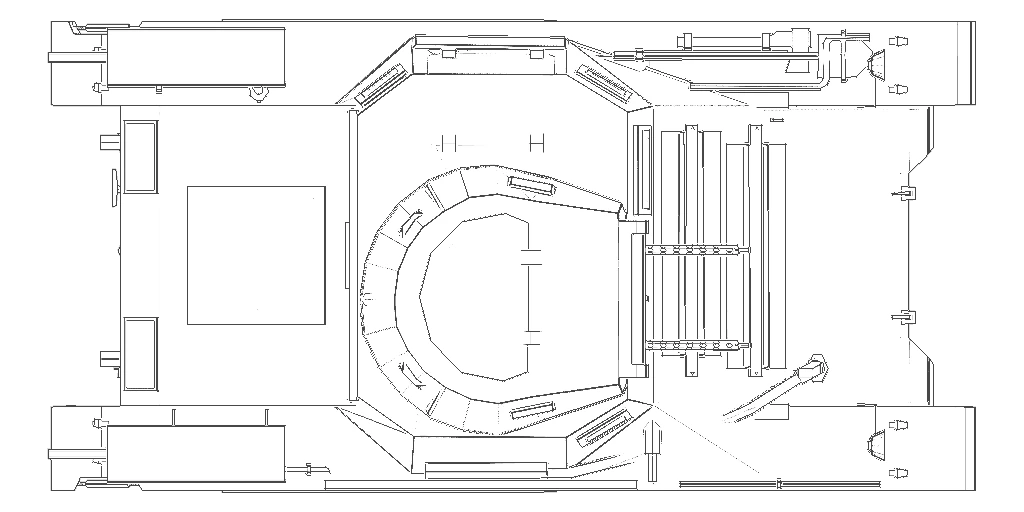
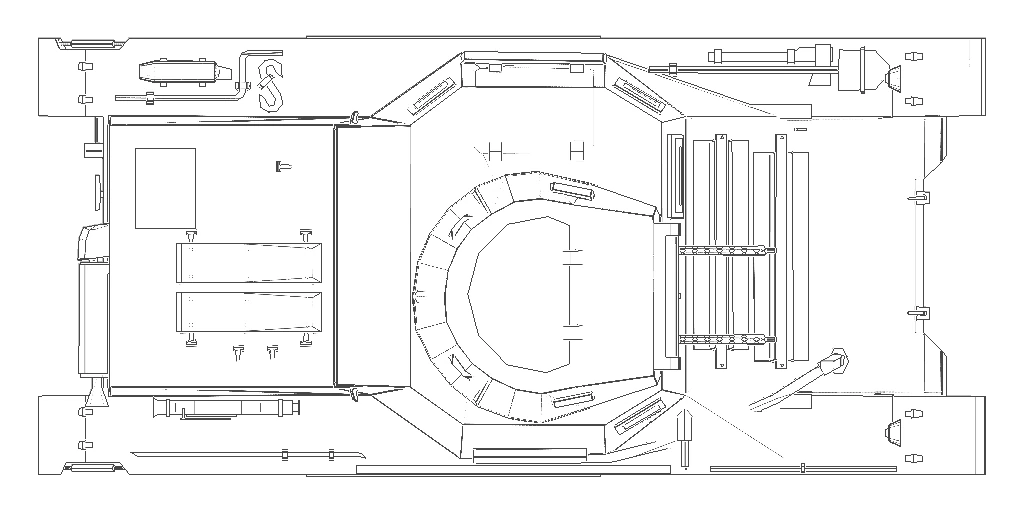
The hull is welded from rolled plates. Front, sides, rear and turret walls are 13 mm thick; the roofs 6–8 mm, the belly 5 mm. That is enough against ordinary rifle bullets and shell splinters, and against nothing heavier: every anti-tank gun of its time goes straight through.
- Sloped where it could be. The glacis lies at about 63° from the vertical, the conical turret walls lean in 20°.
- Vision slits. Behind each 4 mm slit sits a 12 mm block of protective glass, made against splinters and bullet spatter.
- In the game every plate is a plate. Each round is traced through the tank’s own measured hull, turret, hatches, wheels and tools, at the angle it strikes.
Radio
It could listen, not answer
The Panzer I carried an ultra-short-wave receiver, the UKW-Empfänger a, on a 1.4 m rod aerial that folded back into a wooden trough. It could hear orders and warnings. It had no transmitter, so it could not report back.
The game keeps that: a Panzer I hears radio reports from its side, but cannot send a sighting or a warning of its own. And the commander who listens is the same man who is firing and reloading.
Der Wagen führt einen U. K. W.-Empfänger (U. K. W. Empfänger a); als Antenne ist eine 1,40 m hohe Stabantenne eingebaut.
The vehicle carries an ultra-short-wave receiver (receiver a); a 1.40 m rod aerial is fitted as its antenna.
D 636/1, 1 April 1936, p. 14
In PINCERLOCK
Dangerous to infantry, a target for everything else
Both versions are playable German cards. Two machine guns make the Panzer I a real threat to infantry in the open. Anything with a proper gun treats it as a target.
- The twin MG is one weapon. The two guns fire together as one order: ten bullets, each with its own flight, its own hit and its own magazine. A gun that is broken or empty simply stays silent.
- Every hit is physical. Bullets and shells are traced through the plates, engine, fuel tanks, magazines and crew. A 45 mm shot leaves a 45 mm hole.
- And a big shell is a big shell. A 152 mm burst can lift the whole turret off its ring.
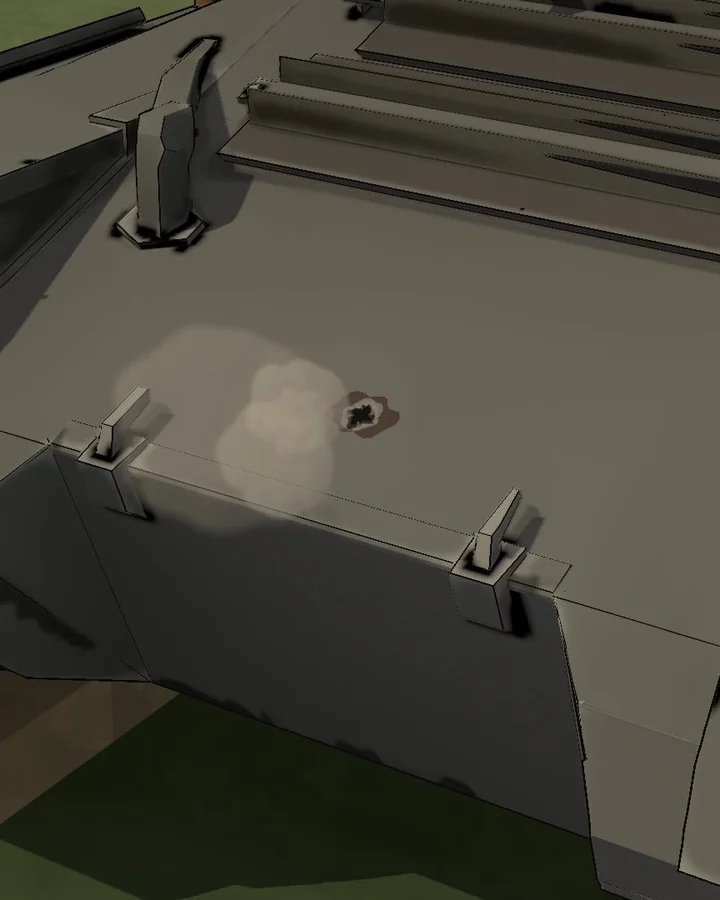
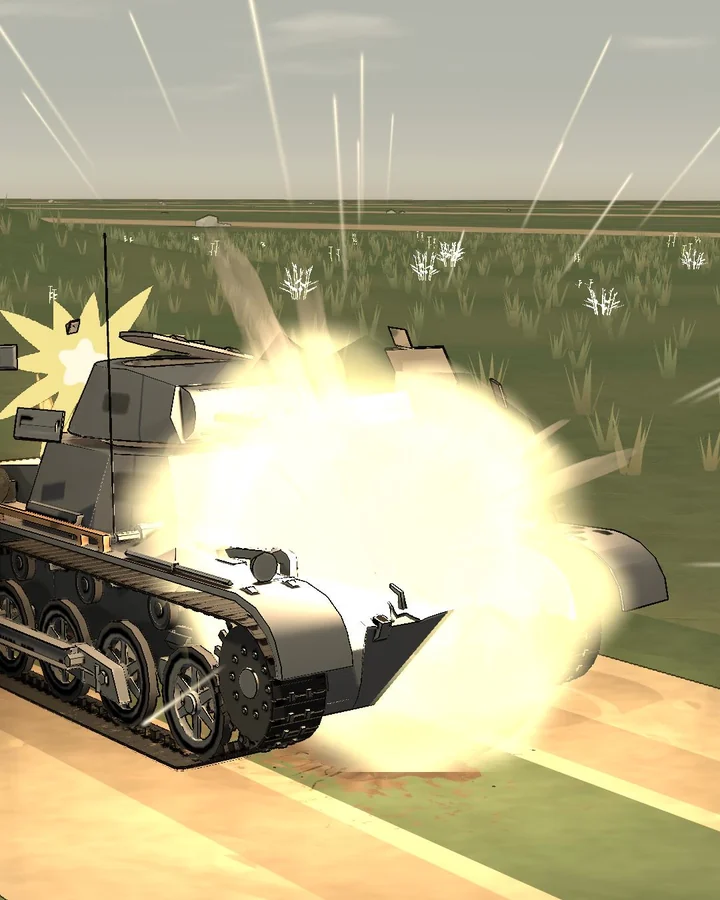
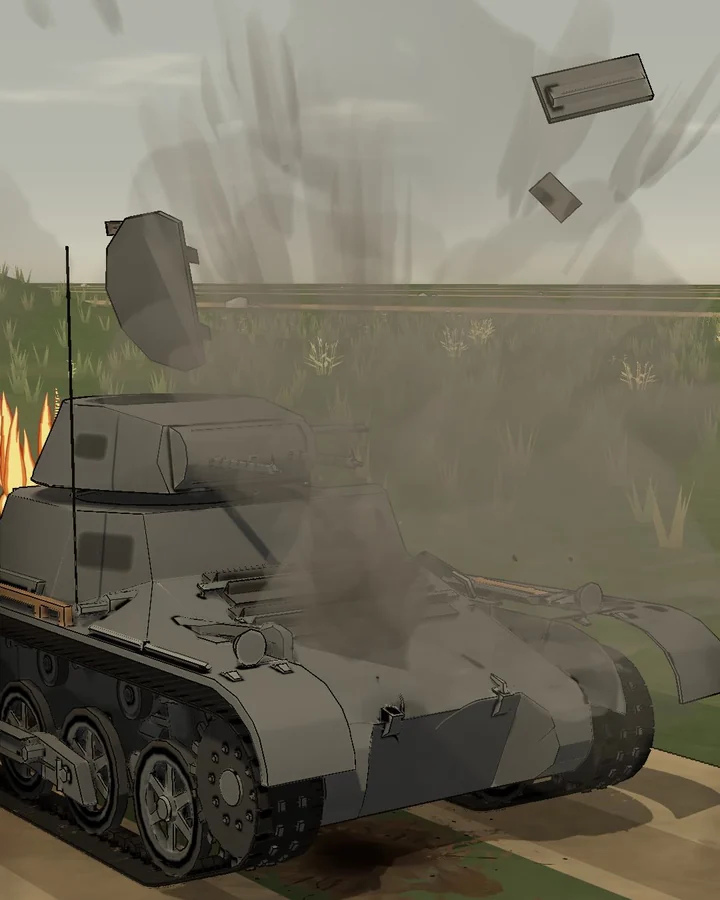
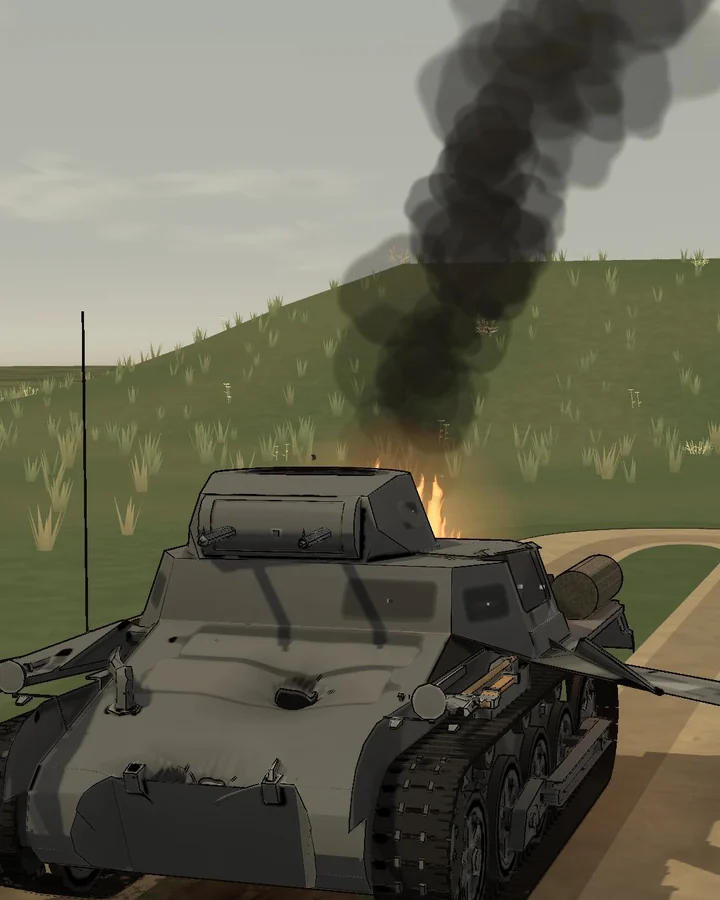
In-game footage in the Field Ink look: KV-2 against Panzer I, recorded range test
Sources
Where the figures come from
The figures on this page are the Panzer I data the game is built on. The main documents:
- D 636/1, 1 April 1936: turret and superstructure manual. Guns, magazines, vision ports, radio, turret drives.
- D 650/1, 20 September 1938: Ausf. A chassis manual. Krupp engine, gearbox, running gear, fuel.
- D 650/4, 23 February 1938: Ausf. B chassis manual. Maybach engine, cooling, running gear, fuel.
- D 650/9, 25 November 1938: loading plan for both versions. Where every magazine is stowed.
- TM-E30-451, US War Department, March 1945: handbook on German military forces, its table of tank sights.
- Instrukcja o broni piechoty, Warsaw 1943: Polish manual on German weapons, the MG 13.
≈ marks a commonly published figure that these manuals do not confirm: overall size, weight, speed, range, elevation limits and production totals. Illustrations are drawn from the game’s own models; footage is recorded in the game.