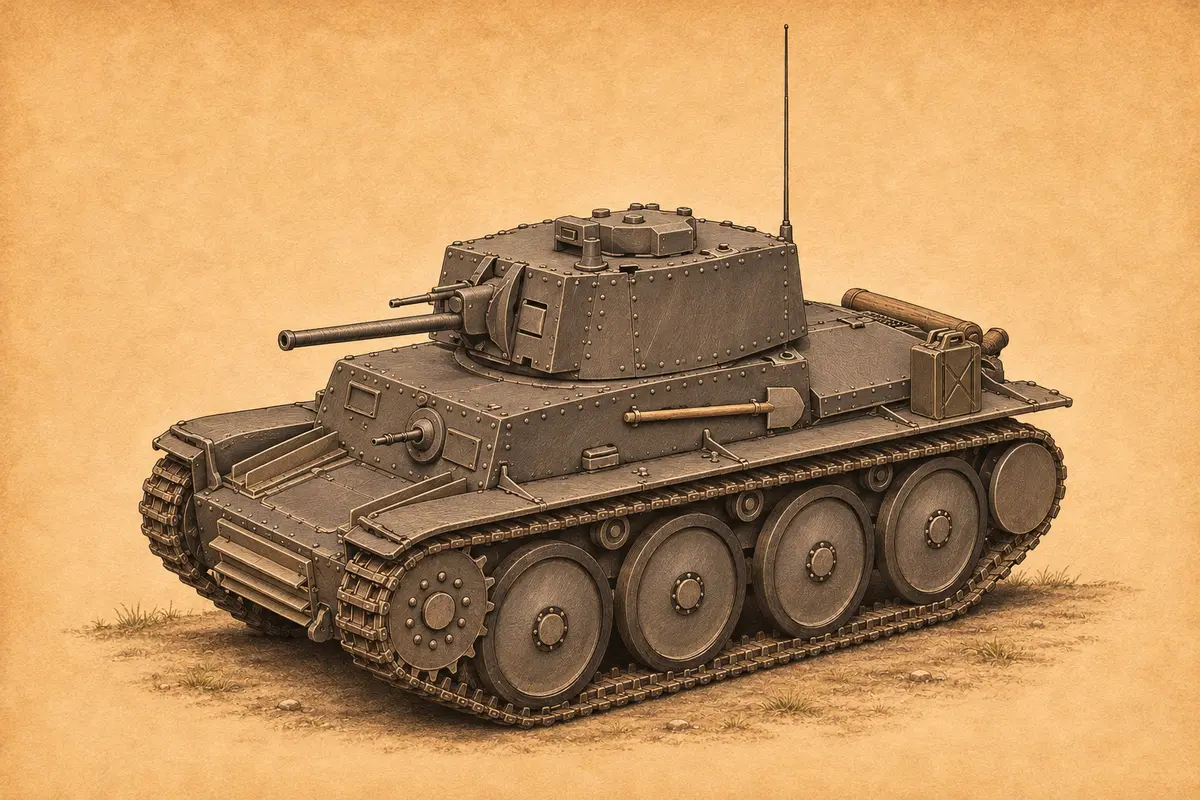
 4
 3.7 cm + 2 MG
 50 mm
 9.85 t
 42 km/h
The turret
A good gun, an overloaded commander
The 3.7 cm KwK 38(t) has a semi-automatic falling-block breech: the loader on the right feeds it, the commander on the left aims and fires it and the coaxial MG 37(t) beside it, while also commanding the tank from the cupola above him.
- Rate of fire. Up to 15 rounds a minute, from 90 rounds stowed in 15 magazines of six.
- The sight. A straight telescope of 2.6×, graduated to 2,000 m, with an open emergency sight to 1,000 m.
- By hand. One turn of the elevation handwheel moves the gun 2° 05′ 56″; it points from −10° to +25°.
- The coaxial MG sits in its own ball, so it can swing about 15° apart from the gun.
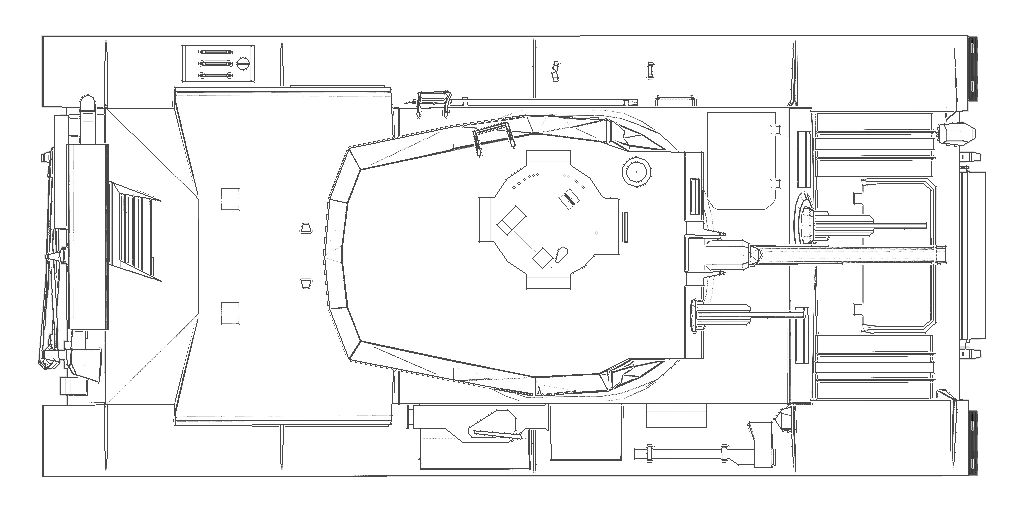
Die Feuergeschwindigkeit beträgt bis 15 Schuß/Min.
The rate of fire is up to 15 rounds a minute.
D 652/38, superstructure manual, 1 September 1943, p. 29
Engine and chassis
Four big wheels
A 7.75-litre Praga six of 125 PS drives the front sprockets through a Praga-Wilson preselector gearbox. Four large road wheels a side ride in two bogies on leaf springs, with two return rollers above them: the 38(t)’s best-known feature, and the reason it was a good cross-country tank.
| Engine | Praga EPA, inline six, water-cooled, 7.75 l |
|---|---|
| Power | 125 PS at 2,200 rpm |
| Gearbox | Praga-Wilson epicyclic preselector, five forward speeds, one reverse |
| Running gear, each side | 4 large road wheels in two leaf-spring bogies, 2 return rollers, front sprocket |
| Fuel | 220 l |
| Length | 4.61 m |
| Width × height | 2.135 × 2.252 m |
| Combat weight | 9.85 t |
| Speed | 42 km/h on roads, 17 km/h across country, 6.1 km/h in reverse |
| Range | 250 km on roads, 160 km across country |
| Ammunition | 90 rounds of 3.7 cm, 2,700 for both machine guns |
| Built | 250 Ausf. F, chassis 751–1000, 1941 |
Ballistics
What the 3.7 cm gun does
Three rounds are carried in the game: the Pzgr umg. armour-piercing shell with a small charge behind its point, the Pzgr 40 with a hard core, and the Sprgr 34 high-explosive shell. Flight times, striking speeds and penetration are the game’s figures; penetration is given square on and against a plate sloped 30°.
| Pzgr umg. | Pzgr 40 | Sprgr 34 | |
|---|---|---|---|
| Type | armour-piercing with a charge | hard-core armour-piercing | high-explosive |
| Projectile | 815 g, 8 g PETN, base fuze, tracer | 368 g, hard core, tracer | 825 g, 77 g TNT, nose fuze |
| Muzzle velocity | ≈ 750 m/s | ≈ 980 m/s | ≈ 750 m/s |
| Rounds carried (game) | 45 | 9 | 36 |
| Rate of fire | up to 15 rounds a minute, semi-automatic breech | ||
| Sight | straight telescope, 2.6×, graduated to 2,000 m | ||
| Range | Pzgr umg. | Pzgr 40 | ||||
|---|---|---|---|---|---|---|
| Flight, s | Speed, m/s | Steel, mm | Flight, s | Speed, m/s | Steel, mm | |
| 100 m | 0.14 | 730 | 51 / 41 | 0.11 | 905 | 85 / 64 |
| 500 m | 0.71 | 655 | 44 / 35 | 0.63 | 657 | 54 / 40 |
| 1,000 m | 1.53 | 573 | 36 / 29 | 1.56 | 440 | 30 / 23 |
| 1,500 m | 2.47 | 500 | 30 / 24 | 2.96 | 295 | 17 / 13 |
| 2,000 m | 3.54 | 437 | 24 / 20 | 5.05 | 199 | 10 / 7 |
| Range | Flight, s | Speed, m/s |
|---|---|---|
| 100 m | 0.14 | 726 |
| 500 m | 0.72 | 639 |
| 1,000 m | 1.57 | 545 |
| 1,500 m | 2.57 | 464 |
| 2,000 m | 3.74 | 396 |
- A shell, not a shot. The Pzgr umg. carries 8 g of PETN and a base fuze: once through the plate it bursts inside.
- The Pzgr 40 hits hardest close in: 85 mm at 100 m square on, but by 1,000 m it is no better than the ordinary shell, and at 2,000 m it is spent.
- Enough for 1941 light tanks. It pierces a T-26 or a BT at any range. A T-34 or a KV is beyond it except, with the Pzgr 40, a T-34’s side at close range.
No original firing or penetration table for this gun is in our sources, so the muzzle velocities, flight times, speeds and penetration are estimates (≈ throughout). The masses, charges and fuzes are from the German ammunition tables H.Dv. 481/127 of June 1942.
Protection
25 + 25 mm, riveted
The 38(t) is riveted, not welded. The Ausf. F has a second 25 mm plate on its front and turret front, touching the first: 50 mm in all. The upper sides are 30 mm, the rest thinner.
- One plate, not two. The game counts the 25 + 25 mm as 50 mm of steel and gives it no extra credit as spaced armour, since the plates touch.
- Riveted and bolted. All main construction is riveted, except the top of the superstructure, which is bolted.
- In the game every plate is a plate. Each round is traced through the tank’s own measured plates, hatches, wheels and tools at the angle it strikes.
| Plate | Thickness | From vertical |
|---|---|---|
| Hull front | 50 mm | 18° |
| Turret front | 50 mm | 10° |
| Upper sides | 30 mm | 0° |
| Turret sides | ≈ 30 mm | ≈ 10° |
| Lower sides | ≈ 15 mm | 0° |
| Rear | ≈ 15 mm | 0° |
| Turret rear | ≈ 25 mm | ≈ 10° |
| Roofs and deck | ≈ 8–12 mm | flat |
| Belly | ≈ 8 mm | flat |
The front 25 + 25 mm and the 30 mm upper sides are from the US Catalog of Enemy Ordnance Materiel (1945); the other plates are estimates from the game’s model (≈).
Crew and radio
Four men, two machine guns
The commander and the loader sit in the turret on seats hung from its ring, the driver at the front right and the radio operator at the front left. The radio operator also fires the second MG 37(t), in a ball mount in the front plate that swings about 30° and ±10° up and down.
The FuG 5 radio sends as well as receives, on a 2 m copper rod aerial that folds back 90°. In PINCERLOCK the 38(t) can pass on what it sees to the rest of its side.
Der Aufbau ist räumlich für 4 Mann Besatzung bemessen: den Pz-Führer, den Pz-Schützen, den Pz-Fahrer und den Pz-Funker.
Die Bewaffnung besteht aus einer 3,7 cm KwK M 38 (t) und zwei schweren luftgekühlten Maschinengewehren MG 37 (t).
The superstructure is laid out for a crew of 4: the tank commander, the gunner, the driver and the radio operator. The armament is a 3.7 cm KwK M 38 (t) and two heavy air-cooled MG 37 (t) machine guns.
D 652/38, superstructure manual, 1 September 1943, pp. 5 and 7
In PINCERLOCK
The strongest German light tank in the game
The Panzer 38(t) Ausf. F is a playable German card. Of the German light tanks in the game it has the thickest front and the best gun: it can fight the Soviet light tanks head on, and its two machine guns deal with infantry.
- Two gunners. The commander fires the gun and the coaxial MG; the radio operator fires the bow MG on his own.
- Choose the round. The Pzgr umg. for most targets, the Pzgr 40 for a thicker plate close in, the Sprgr 34 against men and soft vehicles.
- Every hit is physical. Shells and bullets are traced through its plates, engine, fuel, ammunition and crew.
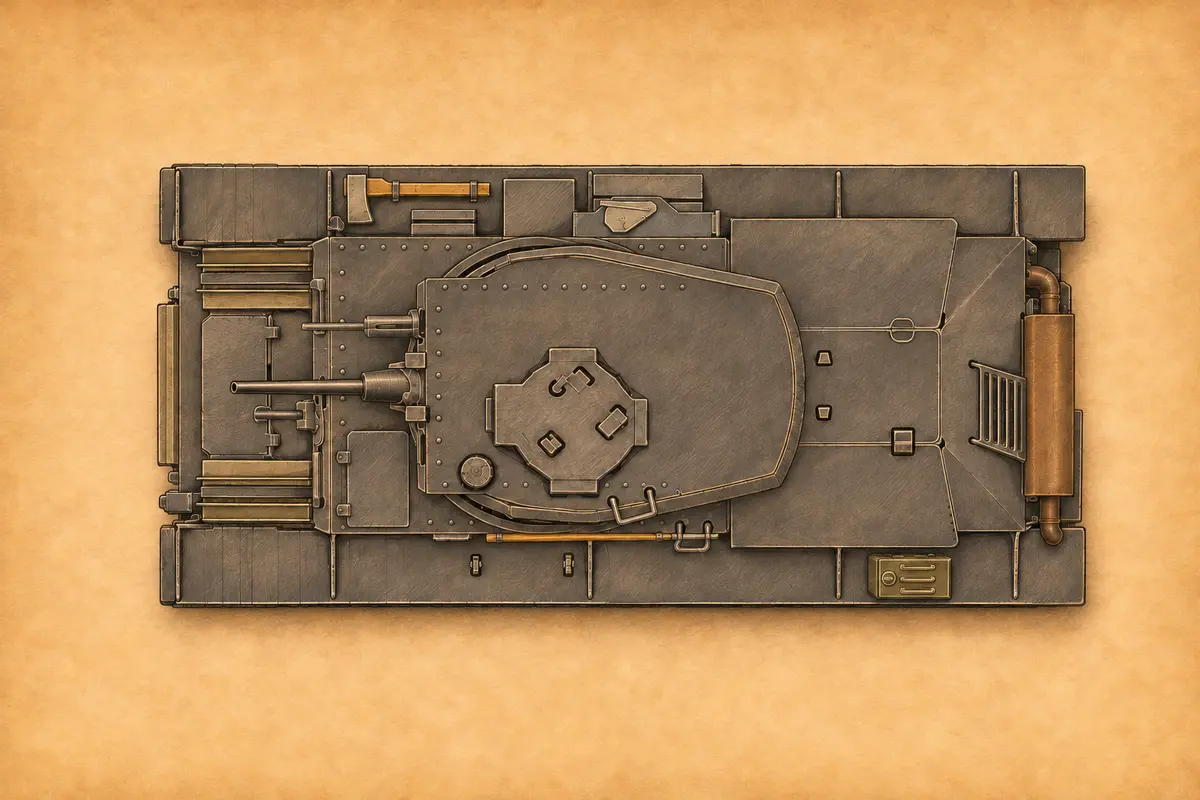
Sources
Where the figures come from
The figures on this page are the Panzer 38(t) data the game is built on. The main documents:
- D 652/38, 1 September 1943: Panzerkampfwagen 38(t), Ausf. A to G and S, superstructure manual. Crew, guns, sight, ammunition stowage, cupola, radio fittings.
- D 652/32, 1942: chassis manual. Weight, speeds, range, dimensions, engine, gearbox, obstacles.
- H.Dv. 481/127, 30 June 1942: German ammunition tables. The 3.7 cm rounds’ masses, fillers, fuzes and charges.
- Catalog of Enemy Ordnance Materiel, US Office of the Chief of Ordnance, 1945: the riveted armour, the 25 + 25 mm front, the MG 37(t).
≈ marks estimates: the gun’s performance (muzzle velocity, flight, penetration) and the plates the sources above do not give. Pictures are taken from the game’s own model; the game’s card painting of this tank shows five road wheels instead of four, so it is not used here.